NEIGHBORING ANIMALS
An Interview with Mary Helena Clark
This conversation focuses on Mary Helena Clark’s 2024 film, Neighboring Animals, a two-channel video centered on the mouth—as a tool to bite and chew, as an instrument of speech, and as a site of disgust and desire. It incorporates footage of animal dentistry, bite mark analysis, and a reliquary containing the tooth of Mary Magdalene. Projected alongside is a text collaging language from psychological studies on disgust, philosophical inquiries on human nature and animality, and poetry. The film was first shown at Bridget Donahue, New York, as part of Clark’s 2024 exhibition Conveyor.
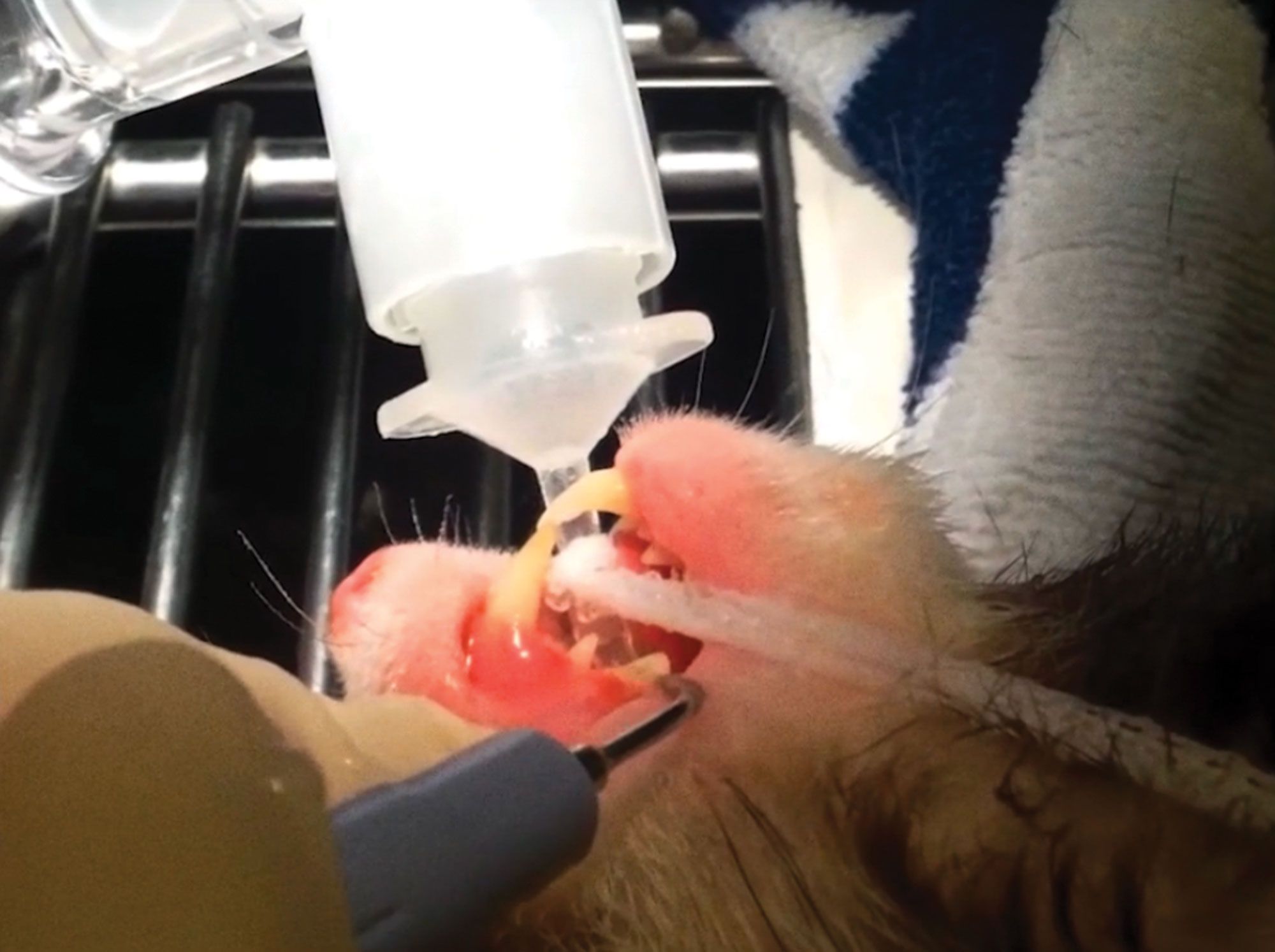
Lakshmi M. Luthra: I wanted to start with what I think of as the first ‘hole’ in the film. A little less than a minute in we encounter the mouth of a ferret that’s being forcibly hydrated and getting its teeth cleaned. And then, a little later on, we see a gorilla, also open mouthed, strapped down and receiving medical treatment. There is a sense in the film, as if civilization, or the human, is coming in through the mouth. Could you talk about how you arrived at that footage and how you think about it in the context of the film?
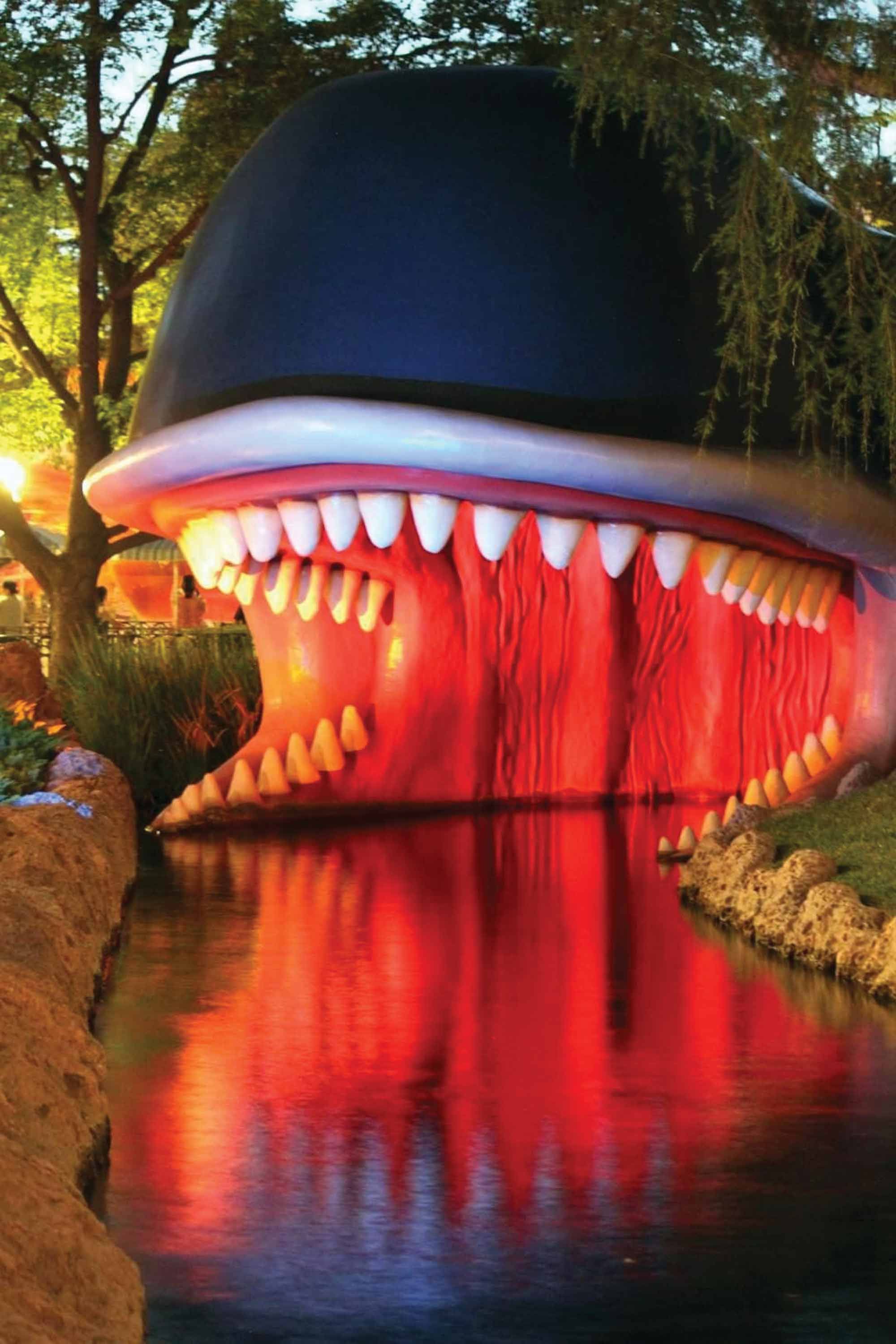
Mary Helena Clark: Usually there’s a sticky image that I know I want at the beginning of a project. I remember sitting in an airport bar, and it was like, “I need to film primate dental cleanings up close.” The feeling was of almost an impossible image—or impossibly close, at the threshold of an open mouth, but with all these big molars and sharp teeth, as if we are perched at the mouth of an ape, or a great ape, and we don’t know if we’re looking at the mouth of a human or a non-human primate. And the mouth is, in the way that it’s splayed open for dental work, also muzzled in its openness. That was important. So, there couldn’t be grunts, or speech, or anything like that to clarify what we’re looking at. That was the image I envisioned. I was going to say, “Oh, it just popped into my head,” but really, if I went back through my unsorted folders of images, I have the Pinocchio water ride from Disneyland in there, with the open mouth of the whale—you enter the ride through this big open mouth. That’s an image that’s been stuck in my side for a long time. And so, I think it evolved from the whale to the ape. I wanted the image to have a kind of toggle effect, that thing where you’re trying to really discern an image, and it's fighting you, and that the proximity to the teeth is the thing that’s frustrating legibility. If it was footage that I was going to produce myself, it meant that I had to get involved in an exotic pet community and I just really turned-off on that. So, I decided to take the approach of appropriated footage instead. The footage that you’re talking about, some of it’s promotional footage from these veterinary clinics, and another one was a news story on gorillas, ‘Gorillas go to the dentist too.’ They’re just like us.
So it was a matter of finding footage that I was comfortable sourcing, and also had a certain level of discomfort to it, tapping into that question of something that feels like subjugation, but is actually serving a role of care. And then the more contemporary footage from the veterinary clinics began to devolve into these much earlier images of animals and primates. In my search for material I turned to psalters and illuminated manuscripts for these other kinds of depictions of animals and human-animal collision. I was finding moments in these manuscripts that either were these circus type images, or just images of animal capture, or sometimes the imaginary hybridity of a human characteristic appearing in an animal—I imagine partly through projection or fantasy, but also allegorically, meaning that these images could enact tales about human debauchery or jealousy or other aspects.
LML: This question of human-animal entanglement brings to mind an idea that comes up in certain strains of psychoanalysis, that the human is something less than animal. So, rather than the human as animal plus reason, or animal plus language, it’s actually the animal minus a kind of instinctual relationship to its own nature — which might be shaped by survival of the species, or adaptation, or whatever these accounts are that we have of what determines the animal. So, according to this idea, the distinguishing characteristic of the human is to have a kind of negative nature, or the absence of a nature. I’m thinking about the great ape as this kind of threshold species, between the human and the animal, and of your interest in being right at the threshold of the mouth, and also this bodily estrangement that I think you’re really interested in in your films.
MHC: Yes, there’s something of that in the way that I’ve framed the human figure in other films. It’s so much about fragmentation and estrangement of a body. It connects to the way I have sometimes riffed on medical imagery, focusing on that apparatus. And it usually relates to speech, because, for me, speech—or voice maybe, is so much where that fragmentation happens. There is a breakdown in the unity that produces a voice. The idea of a self or a purpose, articulated through speech or voice, becomes much more evasive when you think about larynx and lung and breath and tongue placement—all of those things. And the diagramming out of these parts in medical imaging.
I think that this film is doing that a bit more. Rupture was always a word for me with the film; that there are ruptures of desires, disgust marking a point of rupture between human and animal. You talk about the negative, but I think it’s really about repression, and these things that are hidden, pushed down through the apparatus of disgust, which is why I begin the film with these clipped lines from psychological studies on disgust.
LML: I wonder, if we say that the human is not something given, but something that has to be conjured through these processes of repression, can we understand disgust as a kind of lever for inventing the human out of the animal? Hygiene seems like a good example of this, in the way it sets up rules or guidelines for the management of the living organism.
MHC: Yes, like other subjects I have tapped into in other films, I think that the second that you remove disgust from a survivalist or evolutionary rational logic, it becomes far more of an interesting thing. I’ve had comments where people seem to want the film to answer for disgust in those terms, like: “Oh, it’s good that we don’t eat those stinky berries that will kill us.” Okay, but that’s not really the line of thinking the film is about. I get more interested in these efforts to categorize and demarcate these affects that are so slippery and strange, and that do have a million asterisks to them, related to culture, or kink, or any of these things. I love thinking about the tear as a secretion that is somehow exempt, unlike these other bodily secretions, from disgust. I was thinking about the experience, or the rules around this bodily product, and then to push that even further and think of it as something precious, valuable.
LML: In your film you describe the mouth in terms of overlapping systems—eating/biting on one hand, and then language and expression on the other. To that we could add the theory that, in the human being, the hand replaced the mouth as the primary tactile prober through which we explore the world. And we see something like this in the development of children, who start by putting everything in their mouth, not necessarily to eat it, but to know something about it, and then as they get a bit older they want to touch and grab, to lay hands on everything in sight. And of course there are lots of hands in your films, generally speaking, here I am thinking particularly of those gloved hands manipulating the animal’s open mouth. How do you think about the relation between hand and mouth?
MHC: There’s this book by Darwin, Expression of the Emotions in Man and Animal. In it he talks about disgust, linking it with the gape and the mouth. I don’t know if it was photographs or just the written description of the gape—mouth is open, preemptively, ready to expel. The physical presentation of the feeling of disgust is the mouth open, ready to vomit. And an upturned lip. I love that it’s a defensive state, a preemptive state—maybe someone’s shit is making you gag, but it also somehow makes you more vulnerable because your mouth is open. I thought that was so strange, seeing these studies where the photos show that kind of expression on the face—the open mouth. It could mean speech or song, or it can morph into a smile, or it could be someone about to be sick. I love that ambiguity of the physical expression. So, it’s not really about the evolutionary component, but it’s the ideational component, and how much of that is the thinking, the indoctrination, whatever is codified, whatever script you have in your brain about what is disgusting, is presented through the face in this way. It also felt out of time to me that the threat can be imaginary, and that the body is responding to some condition that really isn’t even present.
And then if you think about a child’s interaction with the world, you’re like, “Oh, the mouth is just the doorway of the entire way of understanding the world.” I was reading about children’s development and the idea of a wailing baby—it not yet knowing what is itself and what’s not, what is interior and what is exterior, to be unable to even internalize these affects, these feelings. So in the film, there’s a quoted line about unlocalized discomfort. It’s this moment before the inside really even exists. And I just found that to be so exciting. That stage where, “this is me and that feeling is mine,” those feelings haven’t even cured in the formation of a self. I was fascinated by that.
One of the film’s little secrets is that the metal clanking sounds, the sounds like things being moved around, they’re all the sound effects from this Piaget educational film that shows his experiments with children. Under the instruction of a psychologist, children are constructing spatial scenarios and then answering questions about that space, and oftentimes hitting the threshold of their understanding of the persistence of objects in space. One of the experiments involves a string that is hinged around a nail on a board. And so, when the string gets longer on one side (because you pull it), some of the children think the string has now gotten physically longer, instead of just changing in perspective. I always kind of wanted to use that in a film, but I knew it was too much of its own study to fit in this movie that’s already overstuffed. But I wanted that sense of play and clamor, of experimentation, to run in the background. I didn’t use this either, but the Piaget film is dubbed in English, so the really clumsy ADR is beautiful because the voices don’t quite sit in the body. It’s another form of alienation of voice-space-body.
LML: I want to read that line you mentioned in full, because it really caught me: “The baby who first cries from unlocalized discomfort will, in the course of growth, show progressive ability to identify the distress as her own.” It suggests this non-locatable body, a body without defined edges. And I wonder if we can think about the locating of the body, the finding of its perimeter, as a question of the choreography of the senses?
MHC: Not to sound grand or something, or glib, I don’t know which this would be, but that’s what I think the whole function of a movie should be. I mean, truly. Even in my films that don’t necessarily deal with these kinds of developments, or with the construction of the sense of a human that this film orbits around, I still want each film to grope its way through. For me, it’s the ulterior motive of montage and sound-image collage that it is a constant repositioning of a proposed body. There is a formation of a subject that’s happening throughout the film. I think that’s what films can do. That’s why I keep going back to these developmental studies because obviously they’re approaching this idea too, of when that boundedness of a person happens. And that’s what’s so fun in film, you can stabilize and destabilize. Associate, disassociate.
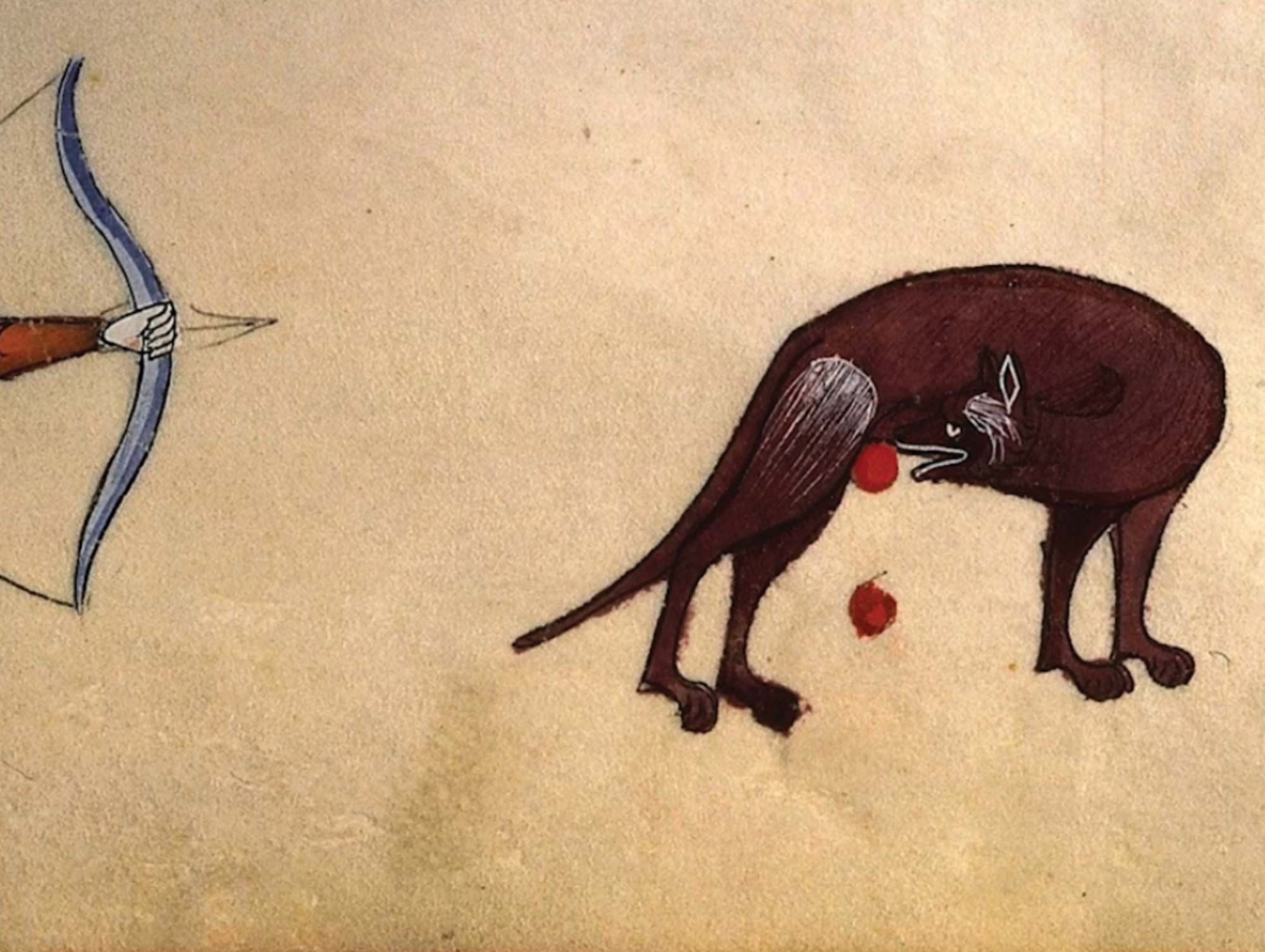
LML: When you introduce the crying baby, we see a drawing of a turned around dog, or maybe a fox, facing a drawn bow and arrow, two red balls dropping from its open mouth. For me there is a kind of electrical charge in the encounter between this image and the unlocalizable distress of the baby. Can you talk a bit about what is happening in this drawing and how it might speak to the text it’s paired with?
MHC: I wanted to use this image of self-violence. It’s a medieval illustration of a beaver, even though it doesn’t look like a beaver to us, castrating itself. We see these big red balls being chewed off, which was the thing the animal was hunted for. It’s nice to have a spherical form in the film tiptoeing towards the decorative eggs that come later, but it’s also this castration happening. From what I’ve read, the illustration is about losing the thing that you’re being hunted for. So, in a way, it’s an allegory of modesty, of having something so great that it becomes a threat to you, and ejecting that from your body in this violent act. That graphs neatly on to my mother’s story about desire for this decorative egg that’s not hers. Those episodes run parallel for me in the film.
LML: In the quotation I think you’ve changed the gender from the original, right? In your version it’s a little girl crying.
MHC: Yes.
LML: So, both the image and the text question the edges of the body. There is this little girl, a baby girl, who doesn't know where her body ends, and then the image of this beaver whose body is also sort of weirdly unlocatable species-wise, and it’s disciplining the boundary of its body in this violent way. It’s castrating itself. It’s giving something away, maybe in order to survive?
MHC: For me, those are the tender moments in the film. The castration is this violent act of self-protection that’s so much about not wanting to be the pursued, not wanting to be the object of desire. It’s an evasion of that position. I think the film recognizes the vulnerability of that kind of visibility or legibility, and maybe feels more comfortable being slippery or edging up to these other affects. Because the film —it’s not really a crescendo, but the film hinges on this story of destruction that comes from desire, revolving around my mother and the decorative egg. In a way, the castration is a very subtle foreshadowing of that later moment. But in this case, dealing directly with the body instead of being about the incorporation of a foreign object into the body. It’s kind of like an ejection of the thing that’s being objectified, which is great because it’s also the genitals. And beaver is slang for pussy. It’s all there [laughs].
LML: There are many points in the film where you evoke the vulnerability of the body (animal and otherwise), its susceptibility to pain, to wounding. So the senses may bring delight, allow for participation in the world around us, but there is also this undercurrent of threat, that our porousness must be carefully managed through things like disgust or sympathetic magic. Can you talk about this management of the senses, which comes up thematically in the film, but also maybe resonates with certain formal choices you make?
MHC: There’s a lot of withdrawal that happens in the film, where it takes you up to the edge. I don’t think of it as an attractive film, or a beautiful film. I think that it’s very tamped down. There is a little tussling with the moving image, it’s always verging on becoming still, which is part of enacting this sense of regulation. It’s also in the way that I do the aperture racks over the egg— constricting the exposure, the dilation of the image into shadow. I think about that so much; the iris acting like a mouth opening wide to feast, or sing, or spew, and a redaction of the image by the darkness consuming it. So, often it’s playing with restriction and limitation in formal terms. And in this film maybe I use these techniques more because I’m dealing so much, like we said, with repression and a sense of these frustrated categories that are unstable in themselves.
There is something too about the formal presentation of it as a two-channel video, where it so clearly could have been one, but because one channel is only text and the other channel is only image, it creates a separation. It was another way of creating distance and cordoning off certain things; separating text and image, separating text from voice, in a film that’s thinking so much about language being formed and acquired. And I projected the film into a corner. Obviously it’s a convenient seam, it’s a convenient situation, but it’s also a space charged with shame. The cuts are also part of it; the shutter going down, the mouth closing, the slide changing, this idea of looking away because something is too much—that kind of regulation. Even though I don’t think that the images are hard to look at, many people have felt discomfort in watching the film. There is something about having the text as this other path, this other option to focus on, away from the image. For me, it evokes a test site or a book, a scenario of viewing, but it’s also this other option, this invitation to look away. I cut out all the gnarliest images. Maybe I should have left them in and activated that a little bit more.
LML: I want to ask you in particular about the use of x-ray, or maybe it’s sonography, in the film?
MHC: There are both. There are x-rays of a swallow test, which is found footage, and then there’s the ultrasound of a tongue, which is also found. When I showed the work at Cushion Works I added a monitor, a kind of third channel, playing an ultrasound of my tongue reading the text in the film. I found this book called Human Dentition. It shows these beautiful models of teeth, photographed incredibly. I use a few of them in the film. They’re sort of vintage, teeth models shot against a black nothing, very dislocated. In the book, there is one shot from below, captioned, “the lingual view.” That turn of phrase was so beautiful to me. I’m imagining this eye on the tip of my tongue resting in my mouth, looking at where the teeth hit—like being on the inside of that Disney Pinocchio ride. That phrase stuck with me, so that when I eventually found this tongue footage, showing this imaging technology used by speech therapists, I got really excited because I was like, “Oh, this really is it. We really can get into the mouth, the mouth view, the lingual view.” Though it’s not really the lingual view in the sense of the view from the tongue, but a view of the tongue. Sometimes the perspective can kind of rotate around to be in line with the tongue, but the angle that I ended up using was more of a profile. It’s another form of estrangement of the body, of our way of picturing ourselves through anatomical imagery. For me, it was also about an image quality and texture that’s so linked with the uterus, to have that transposed to the mouth felt really important in a film where the mouth is the birth of our understanding of the world. And it’s also a film about my mother.
In the x-ray footage of the swallow test we get to see this incorporation, this pushing down into the body of whatever is being swallowed. The x-ray is in a perfectly circular little vignette, which felt like another visual rhyme for the egg form that’s been hinted at. That footage is paired with my mother’s story about biting this decorative egg she wants for herself. Through the x-ray we are able to dive inside of the body, to this place which she felt was the only place she could keep this thing that she loved.
LML: You seem drawn to these imaging technologies that penetrate the body, that allow us to peer inside. They also undermine the stable construction of a given body, of any kind of intact perceptual envelope.
MHC: Totally. That language comes up in Paul Rozin’s writing about disgust—he describes this domain of disgust that’s called envelope violation. So, for me using these camera technologies that penetrate the skin, that image the inside, felt like an enacting of this whole realm of disgust. Although, his rupture, his envelope violation, would be the bone breaking through the skin, some kind of injury like that—the insides are spilling out. The film has this arc from talk of disgust to talk of desire. Desire is enacted by bringing this foreign object in through the mouth.
LML: So the register for experiencing this envelope violation shifts, toggles between disgust and desire. And perhaps we could also say that even though the camera is penetrating and going inside the body, it’s also producing a kind of surface, a skin, turning that inside into an outside, into the flat surface of the projected image.
MHC: Yes, and if we’re moving in the chronology of the film, from that x-ray it goes into this super imposition of the decorative egg onto a real egg. That was always an image I had in mind for the film, from the beginning. And it was like this double skin. It was like decoration. It was like ornamentation as armor, as a doubling, as this fortification after thinking about these ruptures, these envelope violations. It’s another kind of frustration of all those desires that are a part of the film. And it took me a long time to figure out, even though I had that image in mind from the beginning. I kept making these super-impositions where I was putting things inside the egg. And they looked kind of good, but they didn’t feel right, and I couldn’t figure out why. And then I realized that I was fertilizing the egg, and that wasn’t what the film was about. The film was about the surface and this ideation, this fantasy of surface. And this play of the functional and the reproductive and the ornamental all kind of mingling together in that image.
LML: Can you tell me about sound in relation to these ideas? There are these moments where language is being parsed into phonemes, almost musical notes or phrases, and then this slowing down and technical stuttering of speech to study the nuances of pronunciation. And there are other kinds of fragmentation, disassociation and out-of-sync-ness happening as well. Do you think this ‘surgical’ aspect of film, bringing closer, peering into, pulling apart, can also be thought about in relationship to sound?
MHC: A lot of my films deal with slant. I’ve never called it slant rhyme, but it’s a rhyme relationship, a loose rhyme between sound and image that teases the causal effect, but the link is not quite there, it’s more associative. In this film, when the woman says prize, there is a real indulgence in the fact that we’re literally seeing the formation of the word, and, for me, maybe it’s this long delayed indulgence in sync. You know what I mean? Look at where that little grainy tongue formation is rolling when this word is spoken. And I never really thought about that as sort of releasing into the feeling of synchronization or a total collapse of sound and source, where even the image is flattened and in service to explicate the sound that we’re hearing.
LML: But it’s also totally alienated, no?
MHC: Well, it is and it isn’t [laughs].
LML: It’s quite alienated from how we normally see the mouth move and hear speech. Maybe you’ve sunk into synchronization to the point where it comes out the other side?
MHC: Right. And the human is made inhuman again in all of these images. Or alien.
LML: Right. But there we have another flip maybe, where the alien becomes that through which we’re actually able to encounter the question of the human at all.
MHC: Another use of sound that’s maybe more typical for me, there’s the sound of a choir over images of bite mark analysis. The marks are made by lots of little animals biting onto foamcore. Pairing those images with this choral swelling, evoking all these mouths that are open singing, or closed humming, for me, that’s sound transforming what might look like trash into sacrament. It’s a really transformational effect of sound. The film’s formal qualities are then enacting the kind of logic that happens around the relic, where the outcast thing becomes the contact point for grace or holiness, but in any other context it would be biomedical waste, or trash. So, that’s the film performing that logic of the relic, and also just playing around with the subterfuge of sound. There are other moments where sound isn’t undercutting, it’s bolstering. There’s a scene of an orangutan behind glass, on the receiving end of a magic trick. I tapped on a microphone to make this clumsy boom-boom-boom sound, and it clumsily synced up to the orangutan tapping on the glass. I’m working with the way additive sound can add to the veracity of an image, but it’s poorly done. And then it’s also an illusion because it’s this magic trick that’s being done. So, it’s folding in on the pleasures of illusion. That’s just a part of making films.
LML: I think the tapping also reminds us we’re watching a film, because it sounds conspicuously how a sound sounds when it’s been recorded. There’s an almost comic sort of revealing of the apparatus, but maybe that becomes a further invitation to imagine and fabulate around what we’re seeing and hearing.
MHC: Yeah. I like bad Foley for maybe the same reasons that I was attracted to that Piaget experiment, because there’s such spatial incongruities that are happening, when the small sound is loud, and when the far away sound is close, those are the things that are very disorienting and can be accessed in a pretty playful way, but can actually create a bit of an undertow, a bit of vertigo, for someone that’s listening closely. There’s a dislocation; the film can pull the rug out from underneath you. I never know what’s a cheap trick. One other sound that I was reminded of today is the hollow sound of wind over a vessel. There are certain sounds that are my go-to, and for a while it was old radiators, but I think wind over a bottleneck is my new go-to. Because it’s inanimate, but it’s also, for me it’s the gate. It’s the auditory gate.
LML: It’s another hole, right?
MHC: Yeah.
LML: So now I’m going to ask you about the egg at the end of the film. There’s this incredible story that you’ve put in your mother’s mouth. She’s telling this story about falling for a decorative egg. She’s bowled over by its beauty, and she wants to possess it. And to do that, she has this impulse to crunch down on it. To me, it’s this incredible image of one void meeting another; her gaping mouth, the hollow egg. So, it’s this really intense encounter that feels very direct and very visceral, and at the same time feels like a kind of missed encounter. An egg is an object that’s very close to the origin of life, and here it has become ornamental, non functional, unfertilizable. It’s withdrawn from the cycles of growth and decay. So, the animal’s been turned into something decorative, almost an image of an egg. So, I’m wondering if we can think about this urge to bite as maybe the desire to draw the egg back into these rhythms of birth and death. And if you can just talk a little bit about what’s on your mind here. I know this is a story that you have a long history with, that you heard as a child. Can you talk about how you’re preparing us to hear the story through its place in the film?
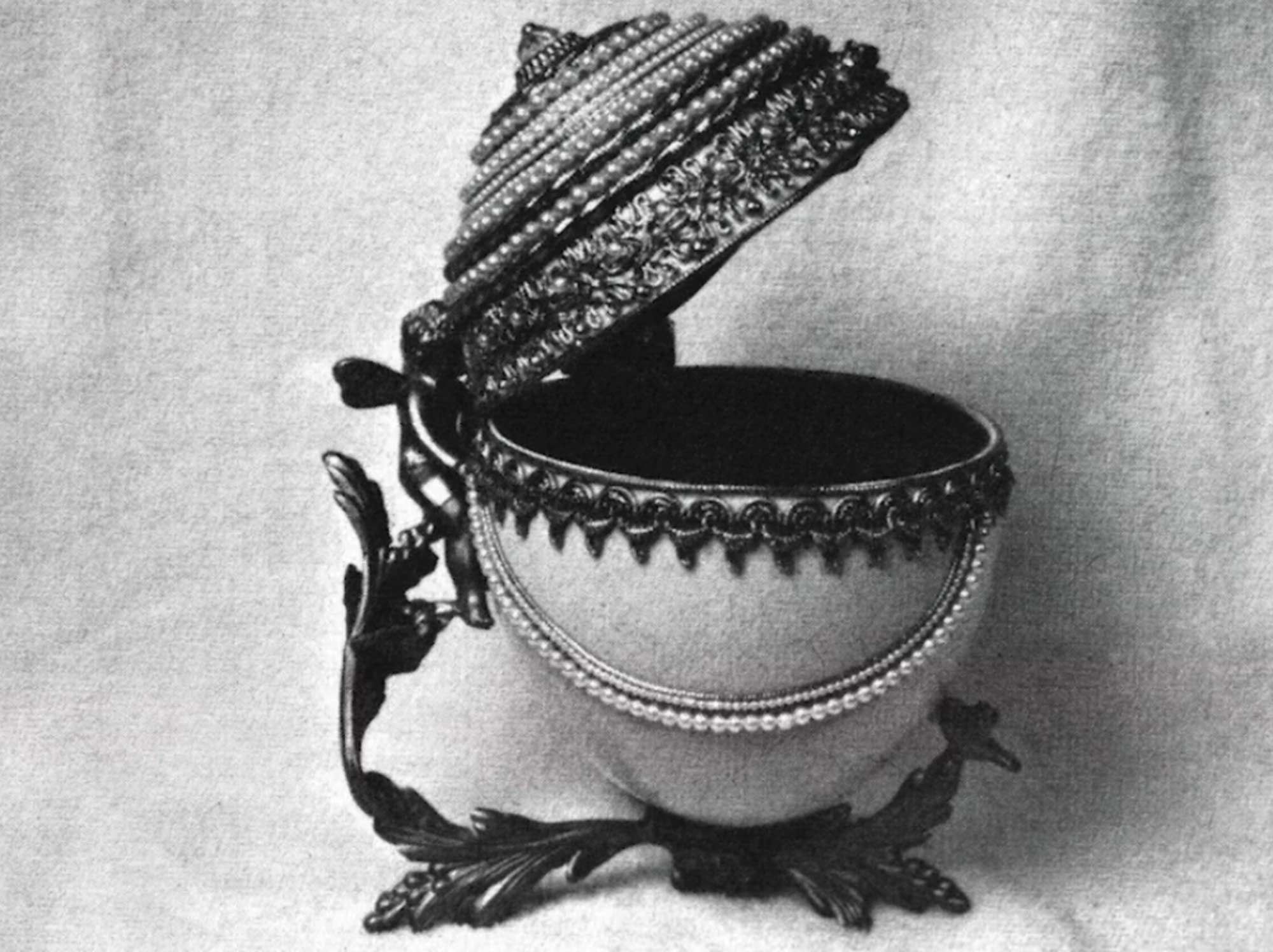
MHC: I still hadn’t found that link for myself, even as I was pouring over these books on Fabergé eggs where they become jewelry boxes and they become sets for dioramas, or they just become pure surface with the addition of jewels and pearl strings. So, thank you, I just fully agree with everything that you said. Even in the way that you described this double negative of the egg going into the mouth, it reminds me of this super-satisfying sculptural impulse where things just fit in together, which is so satisfying, and also very erotic. That is the image I hope is conjured through this story. My mom told this story a lot, and I always snagged on it. It always felt like a confession. When I was little and I heard it, I was just sort of excited to hear my mom tell a story where she was a criminal in a way, in my mind. She saw this thing, and she wanted it, and she had to take it. But she wasn’t just going to steal it. She came up with this other way. Later I thought, “Oh, this symbol of reproduction is being destroyed. It’s this rupture of this desire that can’t be contained.” The story also pushes my mom back into this more infantile place where to have and to know is to put in your mouth. I still haven’t gotten to the bottom of why this is a story my mom tells, which I love. I think I told you, “My mom doesn’t know what story she’s telling,” and I think you were like, “Are you sure?” And so, maybe she does. Maybe this is her and I communicating on a really clear level, and I’ve been denying her the agency and the story she’s telling. I felt like the story contained everything, so I wanted to make a movie where it was only this. It was only this, and I would cast my mother’s voice, I would choose my mother by casting an actor to read the story, and it would just be an image of an egg. But that’s not at all the movie I made. I was incapable of making that film. I think that’s because the film had to move through all the ways that I was understanding what her gesture meant. So the movie analyzes my mom’s artistry, modifying this ready-made decorative egg [laughs]. I’ve never really thought about that, but I think it might be a new way to think about it, as nonverbal communication. The other aspect is growing up in the South, in a very mannered, mannerly household. That’s probably why this story always persisted in my mind, because it broke all the rules. It was telling the secret. And with a lot of decorum and demureness, this is actually the headline. Appetite and desire, Appetite, desire, trespass, destruction.
LML: Perhaps can we hear the story as an encounter with the desire of the mother—something psychoanalysis has a lot to say about. And a somewhat terrifying encounter at that. In the film you include a line, from Bataille, about the mouth as the beginning of the animal, the “most living part” and “the most terrifying for neighboring animals.” So this got me thinking about the mother as the beginning of us all (we might say Courbet’s Origin of the World proposes the vulva as “the most living part”), and as, in Lacan’s words, “a locus for something excessive and as yet unknown—that will serve as a template for all the child’s future attempts to interrogate the nature of objects.” The emptiness of the decorative egg feels to me like a kind of defense, an evasion. The mother’s teeth crunch down, but they crunch down on nothing. It’s a terrifying image, but also holds a feeling of exhilaration and freedom, of escaping fate, escaping origin.
MHC: If the film can gesture towards any of those ideas, I am so happy. I feel like the film is wrestling with, and trying to reconcile with, that one gesture, because it holds so much. There is a looking away, or a pushing away from the reproductive imperative, the idea of the origin being birth and the ability to give birth. There’s something so powerful about a mother telling a daughter a story where her most living part is her mouth, just feeding on the world and taking what she wants and destroying this symbol of creation. It felt like a code, a sort of coded message that needed to be amplified through what I do with my work.
I read this poem by Emily Dickinson, “I had been hungry, all the Years.” I used the last few lines of the poem, twisting my mother’s voice into Dickinson’s. It was the right come down because it’s about being held in the wanting more than in the having. The lines are, “I was hungry — so I found/ That hunger — was a way/ Of persons outside Windows —/ The Entering — takes away —” The act of entering into the space of plenty becomes the way of desire, appetite and desire become spatial. I’m interested in an understanding of the body as a kind of threshold that’s also an enclosure, as impossible as that might be, which isn’t, I guess, a problem in a film that has so many folds and inversions to it. I misspoke earlier. I rewrote the line of the poem so long ago that I forgot the original. Emily Dickinson says, “Nor was I hungry,” and I made her hungry.