VANISHING POINTS
An interview with Paul Pfeiffer
Jan Tumlir first met Paul Pfeiffer in early 2023, after a lecture the artist gave at ArtCenter College of Design in Pasadena, California. Throughout his career, Pfeiffer (born 1966, Honolulu, Hawaii) has developed a distinctive approach to visual erasure, excising figures from sports footage and popular media to expose the architectures of spectacle. In his work, ‘holes’ are sites of trauma, repetition, manipulation, and control.
Following a series of critical exchanges and projects, this interview was conducted by phone after the closing of the artist’s major survey exhibition at MOCA LA, Prologue to the Story of the Birth of Freedom. In this conversation, Tumlir and Pfeiffer explore the function of voids—in editing loops, digital subtraction, and perspectival collapse—and how they resonate conceptually, as analogues for the vanishing points of subjectivity itself. The discussion culminates in a meditation on Pfeiffer’s model for a one-million-seat stadium, Vitruvian Figure (2008), where the spectator’s gaze is channeled into a monumental abyss.
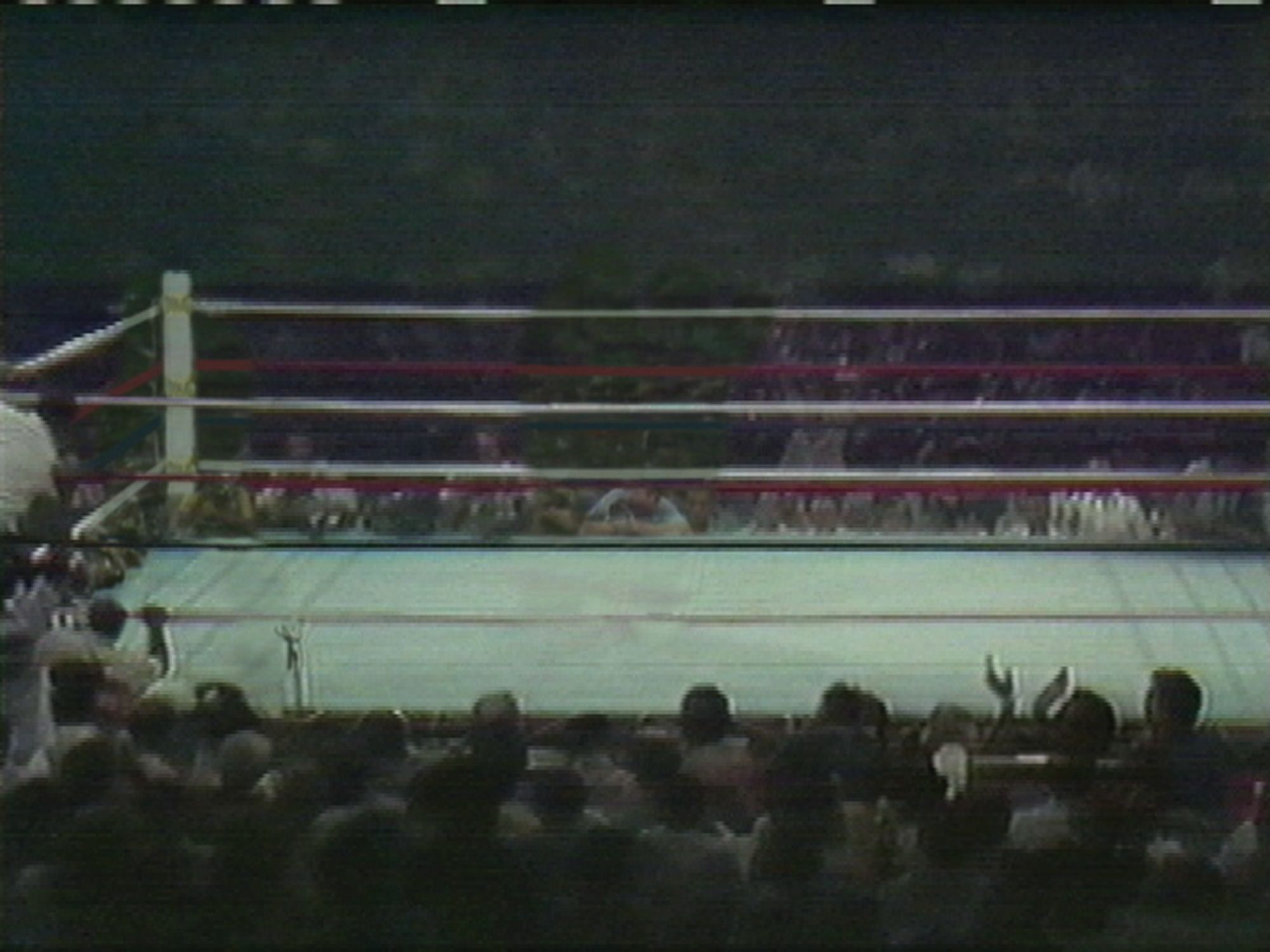
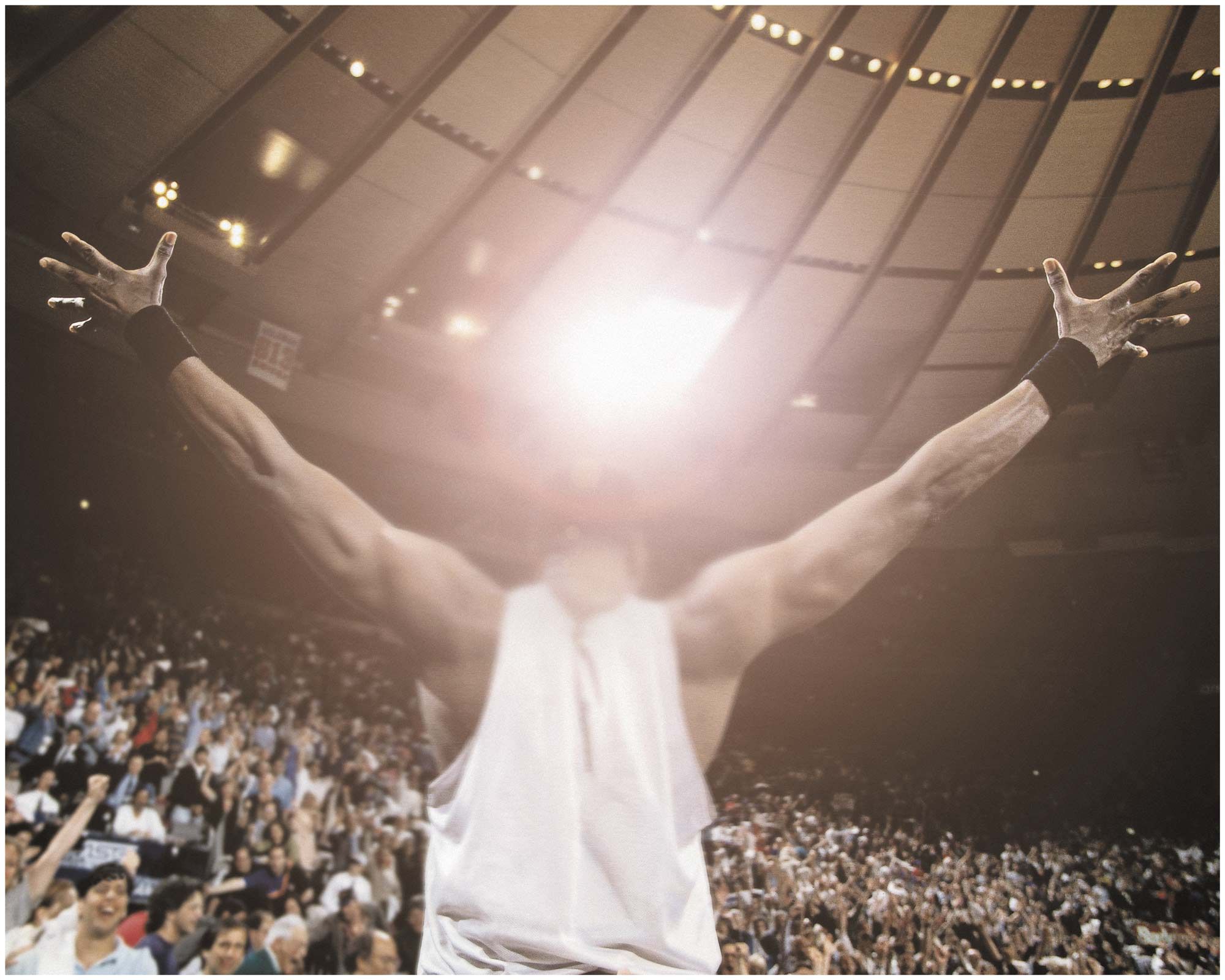
Jan Tumlir: One of your principal strategies as an artist is erasure. As an example, in the series of works that comprise The Long Count (2000-01), there is the elimination of the boxer from the televised record of the boxing match. I’d say that this produces a kind of tear in the fabric of the image. The disappeared figure ‘shows through’ to the background of the spectators, and this is because his silhouette is still discernible there, wafting through the arena. How exactly is this effect produced?
Paul Pfeiffer: There’s an editing process involved that generally relates to rotoscoping and to compositing. It starts with a basic survey of the action in the clip. There’s basically a foreground element, which is the boxers, and then there’s the ring itself with the audience visible outside the ring that constitutes the background. The first step is the rotoscoping process, which is a traditional cell animation process in which an object to be isolated from the whole picture is silhouetted.
Traditionally, it would have been cut out with a stencil, but now with visual technologies, you’d be using roto-splines and a pen tool, going around the boxer to create a silhouette with their arms and legs and torso and head included in the silhouette, and then going frame by frame to adjust that silhouette as the figure moves through the clip.
One aspect of this operation that’s become fundamental is its partial automation. Rather than going from frame 1 to 2 to 3, and so forth, you might start on frame 1 and then go to frame 10 and adjust the silhouette with the roto-splines to account for the movement between these frames.And then the software does its best to incrementally break down that movement on all the frames between frame 1 and frame 10. It divides the space of the distance of travel; it gives you an incremental step adjustment. But that only takes you part of the way because the automated part of the process is only partially accurate. There’s many nuances that the software can’t see. So, you then have to go back, looking for discrepancies and making often very minute adjustments to capture all of the nuances that were missed in the first automated pass.
JT: So, you silhouette the figure and then you have to fill in that silhouette. What does that process entail?
PP: The second step is the creation of a single frame, like a Photoshop file, that gives you a kind of clean background plate, as though the boxers weren’t there. All you want in this background plate is the empty ring and the audience visible behind the ring. And if there’s two cameras showing you two different angles, then you need two clean background plates. Also, if the camera pans, that would necessitate a background plate that is bigger than the aspect ratio of the playback screen, that shows you a wider panorama of the ring and the audience. Once you’ve got that one-frame Photoshop file, the next step is to create a motion track, and the motion-tracking process once again uses semi-automated machine-vision. The way it works is that you set a sample point in the first frame of your footage that represents an element in the image that, as much as possible, doesn’t change over time—let’s say, a corner post of the ring. And then you use the software’s built-in algorithm to track the clip frame by frame, and the algorithm looks for that same sample point in every single frame. It will then present you with a linear kind of point-by-point map of where that sample point is on every single frame. So, if the clip is, say, 100 frames in duration, you’ll end up with a line showing you 100 points in a linear movement that basically represents the movement of the camera, since that’s what the algorithm analyzes and tracks.
What you can now do is apply the motion track to the clean background plate, placed by behind the silhouette boxer rotoscope, which has been converted into a mask. The mask turns whatever is inside the silhouette into just an empty space, and because it’s empty, the motion-tracked clean plate that’s a layer behind the image shows up through the mask. And if the motion track is accurate then the background moves in tandem with the motion of the camera, basically filling in the space where the boxer used to be.
JT: But in this case, we have to contend with a certain measure of inaccuracy, right? Because some part of the boxer’s outline is retained in the footage. He is both there and not there.
PP: Right. This, again, is due to the very painstaking artisanal editing process that I was using in the early 2000s. Despite the partial automation and all the benefits of using digital tools to go through this process, inconsistencies from frame to frame show up as a kind of disturbance in the image right around the silhouette of the figure where the motion-tracking isn’t 100% accurate. It appears as a kind of trace of where the figure used to be. You’re seeing that clean plate through the mask of rotoscoped boxer, it’s like you’re seeing through them, but some trace of the outline where the editing work took place still registers to the eye. What’s happening in that moment is that the natural working of the eye to locate the most prominent motion going on—let’s say, the motion of the camera as it’s moving from left to right—is being challenged.
JT: It is interesting to think about that space you’ve created as a hole of some sort.
PP: Well, the term hole makes me think of a void. Like I often say—and maybe it’s just become a saying—but what appears as an erasure is actually an act of camouflage. I think of insect camouflage in which pigment cells in the skin of an organism—an insect or a reptile, for example—will adjust themselves, based on some kind of perception of the background texture that the organism is standing in front of, to match that texture. Or, adapted to a human scenario, like in wartime, there’s various patterns that can be worn, depending on the environment that a soldier is in, to help the soldier blend in with the landscape and hide himself. That said, I’m intrigued about the thematic evolution from the issue of camouflage to holes.
JT: By the way, camouflage, in the writing of Roger Caillois, involves the production of what he terms “dark space.” So, the figure that is camouflaging, or that is disappearing into the scene, this figure eventually enters a kind of blind spot of consciousness.
PP: OK, so what comes to mind in relation to holes and voids, when you invoke the pieces with the boxers erased from the ring, has something to do with an absence that’s left when a kind of normative alignment of phenomena is interrupted or disturbed. In this case, the silhouette that’s left where the boxers used to be, and what you’re now seeing the audience through, that space, for me, appears as a formal kind of collapsing of foreground and background, which, again, is why I think of camouflage. But another way of thinking—or unthinking—brings to mind that kind of alignment that maybe more immediately relates to the moving image, and to perception in general: a kind of assumed thinking along different sensory channels.
JT: This, first of all, has to do with movement: we perceive the silhouette because it is moving.
PP: This is, I think, a general principle in perception, specifically visual perception. There is a way in which movement serves to activate the sensors in the eye and therefore movement is necessary to make vision possible. If there was no movement, the sensors would have no baseline to establish difference and would, in a sense, just switch off. So, movement is necessary to simply activate vision as a sensory channel.
JT: That’s what happens organically, but then, in regard to the moving image and to your processing of it, sometimes this “assumed thinking along different sensory channels” is disrupted somehow.
PP: Right, I was just talking about vision and how it works, and, I guess, the role of difference in sensory input in creating the image. Then there’s the relationship between different sensory channels. But I think that there’s a similar way in which the different senses are being activated and brought into alignment, which also is partly automatic. It’s a kind of default function of filling in the gaps in which, say, sound and vision sensors and the haptic sensors of touch or spatial orientation, right along with smell and so forth, each provide clues to the object that’s in front of us. There’s a kind of real-time processing that goes on in the whole machinery of perception, filling in, bringing senses into alignment to create a kind of registered image that presents itself as the object.
This, to me, is very resonant when I think of what I do in the editing studio—going through the rotoscoping process, the motion-tracking process, the process of analyzing and creating a clean background plate, and then ultimately compositing a number of different layers together. To pull together one clip, there may be 20 to 30 layers, each one doing something different. And so, after having focused on these layers one at a time, the final step is to composite all of them together. There’s a correlation between what goes on in the editing studio and what’s happening as part of a general process of perception to bring different sensory channels into alignment.
JT: OK, but the object—in this case, a boxer—is removed. Here again, I want to say that you’re also working to disrupt sensory alignment in some way—maybe on a formal level. As an editor, you actually take apart all of these channels; you attend to them separately, right?
PP: Right. As an editor in an editing suite working on a video—working in After Effects, for example—you’re playing with the layers of an image in a very focused and technically minute way, so that you become attuned to this constant mutually constituting nature of the elements in the video, so much so that, as an editor, you’re constantly aware of the equal weight that the positive element and the negative element, or the foreground and the background elements, carry in the image.
JT: Yes, they are “mutually constituting,” but then you, the editor, are attending to all of these elements, or again the layers that make up the image, separately.
PP: This is fundamental and characteristic of the editing process in general. To produce just one minute of real-time edited footage that appears as the kind of seamless naturalism we’ve come to expect, with everything fully synced, is hard work. There’s a big distinction between what appears like naturalistic time to the viewer and the reality of the manufacturing process, which I think of as editing time, where one minute of footage can take hours, even days, weeks, months of work. But, in a way, I would say that what’s happening in the process of perception generally is that there’s a similar kind of labor of alignment that the body and the sensory system is performing to simply stay in real time. There’s a kind of shorthand processing that’s constantly going on to approximate and bring all this sensory input into naturalistic alignment, second-by-second and minute-by-minute.
And, as every editor knows, there are techniques that one can use to capitalize on this process of perception—on the kind of natural, organic approximating that’s going on at all times—to take advantage of the blind spots, to take advantage of what is constantly missed as the perceptual system goes through its shorthand process of approximating things. It’s like the logic of sleight-of-hand magic. The eye is always looking to prioritize what’s most important to pay attention to and will tend to follow a hand that’s moving and miss that the other hand, which seems not to be moving, is actually doing something else.
JT: Well, what you are doing in The Long Count could then be described as a kind of counter-magic inasmuch as you are directing our attention to what gets missed when every eye is trained on the main event. You remove the boxer to expose something else. Another take on that hole, if we want to put it that way, is that the residual silhouette also frames—or, maybe better, vignettes—spectatorship as such.
PP: Yes, and in reference to your mention of dark space, this becomes complicated. I think of the fabric of the image as representing a kind of wholeness that somehow mirrors the wholeness of the perceiver. So, the association I make with your line of thought is this: to perceive a hole in the fabric is to enter a dark space that somehow similarly represents a dark space on the receiving end of the process.
JT: The focal point has disappeared and now we’re framing the act of looking. So, one is looking at other people looking. That creates an unstable situation in the image. But still another way to look at the hole is that it makes a space in the image for the watchers and the watched to become one. And, again, this relates not only to the content of the image, where the spectators and the spectacle are, in a sense, superimposed; some part of that situation is also carried over to us, the present-day viewers of your image.
PP: Absolutely. Again, I feel that it’s a disruption of an assumed one-to-one relationship with the object. That’s the point of focus. The relationship that interests me has to do with that kind of mutually constituting condition of seeming opposites.
JT: There is maybe a rhetorical side to this operation. What this image of yours says is: this mutually constituting relationship is something that’s always happening. Such figures, these boxers, do not only move on their own; all those eyes that are trained on them are also making them move.
PP: And this comes back to this sort of intuitive one-to-one relationship between a perceived object and a sense of wholeness, maybe even control, that’s experienced by the perceiver. When a mutually constituted relationship like that is disturbed, thrown off balance, I feel that the effect that’s produced has less to do with the kind of self-awareness of being the perceiver per se and more to do with something that I would associate with that inherited term, the uncanny. There is something so naturalized about that one-to-one relationship that to disturb it doesn’t necessarily bring about self-awareness; it’s something more like the return of a disavowed element—which reappears as alien.
The easy word for it is that there’s a kind of ghost. This is, to me, coming from the language of psychoanalysis, where it refers to the trace of something that appears out of place—say, the appearance of a loved one who is actually dead and gone.
JT: These thoughts about moving versus being moved could also be discussed under the heading of participation. Your work deals with spectacle but also participation—or, to invoke that ancient Greek term, methexis. So, the question is: to what extent does the audience produce the spectacle? On the one hand, as you’ve already mentioned, there is that sense of mastery and control that’s experienced by the spectator, as subject, when they objectify the boxer, for instance. On the other hand, there’s the argument we get from Guy Debord and others that, actually, the spectacle is wholly imposed upon us, and that we are in some sense its product. It is the spectacle that’s making our eyes, our bodies, and minds move, and thus constituting us as what we are, as the subjects we are under late capitalism, etc. But in the space of this hole, this dark space, we might start to consider a third option. This is where the spectators and the spectacle simultaneously produce each other. It’s neither a top-down nor bottom-up process. So, one could say that your work does not mount a critique of the spectacle; it is maybe more a critique of the critique?
PP: Yes, absolutely, one of my investments is in some way to rethink inherited notions of the operations of the critique. I’ve always been interested in how these involve an idea of critical distance, which I don’t know that we can really maintain, if we ever did maintain it.
JT: Even when one says we are powerless in the face of spectacle, that very statement is an operation of power. So, to collapse the distance between foreground and background, as you put it, or the relations between mover and moved, and then ultimately between subjects and objects, this again produces an uncertain and volatile sort of dark space within which to reconsider the entire scenario.
PP: Another association I make with the dark space is the unconscious. So, it’s sort of already there in the constitution of consciousness. But its function, and in a way its nature and its effectiveness, has to do with a kind of relative invisibility.
JT: How can the unconscious be framed by an apparatus that has no unconscious? And further, how can the operations of memory be framed by an apparatus that has no memory precisely because it cannot forget anything? The element of forgetting is integral to memory; this is a point that’s made by many thinkers including Freud, Bergson, Benjamin, and others. These also argue that that which has been immediately forgotten, perhaps because it was traumatic, stands the best chance of being remembered in full. Trauma, because it is instantly repressed, relegated to the unconscious, stands the best chance of returning in its full experiential scope. I’m saying this because trauma is literally inbuilt into boxing. So, again, how are these psychic operations framed by an apparatus that does not forget, does not experience trauma, and certainly does not experience pain?
PP: In some ways, consciousness and that unconscious aspect are two sides of the same coin. I think of the apparatus as part of this equation. The digital recording device, because it’s translating image or sound into this thing, promises a kind of technical and theoretical permanence. There’s an indelible quality to the recording, which could always be reconstituted from the same data. So, there’s an idea of the device as a mechanical extension and, by definition, it’s separate from the perceptual apparatus that takes in the recording when it’s played back. But this distinction, for me, becomes questionable because, although we’re not there yet, there’s at least the idea that we’re entering into a moment in history where the device may actually be planted in the skin, or even in the eye, in the actual tissue of the body. And there’s also the possibility of a kind of nanotechnology in which the memory, as a chip, is constituted on a cellular level, such that the organic kind of biological memory becomes not so distinct from the technological memory.
JT: Yes, at which point, it becomes something other than memory. I think Elon Musk, Mark Zuckerberg, and the rest are busily working on this technology as we speak.
PP: The more that I work in the editing room and play with these images, I begin to ruminate—I almost want to say, on a poetic level—that there’s a kind of gray area in which the mechanical device becomes almost indistinguishable from the biological. This is in some ways a metaphor for a bigger process that’s going on. There’s this idea of simultaneously occupying two different worlds, and so the question concerning the distinction between real and virtual space is becoming familiar because of the emergence of these new devices. This is taking our imagination of the future into an area where, one could argue, it might already be happening. And, therefore, the kind of the clunky version of the device is only the most familiar and accessible kind of metaphorical version of something bigger and more obscure that is going on existentially.
I’m suggesting that we’re entering into a period where a gray area is appearing in the formerly clear distinction between the human and the nonhuman. And I’m also suggesting that that overlap, that ambiguous area of the human, which is also the nonhuman, has possibly been a foundational part of our reality for a long time, and yet we’ve chosen to repress it.
JT: Can we talk about the unconscious as a sort of hole in consciousness in the same way that the boxing figure is the hole in your image—this hole that we sense as animated and stirring with a ghostly potential?
PP: Absolutely. Conscious awareness is something I associate with a kind of normative space and time. You know, it’s like the culmination of everything we learn and experience. A whole set of assumptions constituting a kind of background context comes into play every minute of every day as we process the things that we see and experience. We draw on this normative background context to very quickly make meaning of everything that’s happening and, in that sense, it’s like the film playing in real time. How we interpret the things we experience—like, how we interpret what people think as a result of how they respond to us and the emotions that result—that’s all related to a lot of learned behavior. So, there’s always a kind of constructed story in which we’re purposefully editing out a lot of inconsequential information in order to focus on the consequential part. It would be too much to process all the information coming at us. We’ve got a very sophisticated system in place to ascertain just what to focus on and what to make of it at any given moment.
JT: And sometimes the conscious mind, to protect itself, will also erase certain stimuli that are extremely important, perhaps of essential importance, but just too painful to deal with. Ostensibly, these are the contents that get relegated to the unconscious, where they actually are stored in a quite pristine fashion. Because then they can reemerge in full at some other time when one is perhaps more able to process them.
PP: There’s that portion of our experience that is either too much information and not consequential enough or very important but too painful—it would just stop us in our tracks. All of that extra information is relegated to the unconscious while you’re awake and therefore it exists; it comes back to you when you’re asleep.
JT: So, we’ve mainly been talking about what’s going on in the image where, one could say, the eyes of the spectators are also framed, or again vignetted. They appear within the space of this image as a ghostly silhouette, and from there also point back to the lens that delivers this image in its entirety to us. As I see it, the eyes of the audience become like reflectors, like crystalline facets reflecting the operations of the overseeing apparatus.
PP: I’ve always thought that the residue of the editing process appears almost like water, or like a ripple on the surface of the image—a disturbance. I put it that way because it lies close to the origin of my own discovery of digital images. The pieces that make up The Long Count were produced within the first months of my involvement with digital processes. And the digital material itself, what it came out of was a vision I had of intensifying the image by removing elements, to amplify a kind of ambiguous scream, like that of a figure in a fragment of the crucifixion. Again, I was working in a very slow, painstaking way. And then, when this process was completed and I played the film back, I found that what I thought had been a completely seamless erasure while going frame-by-frame appeared as a ripple when played back at full speed. There were these little imperfections that I had made, which passed when I was only looking at the footage one frame at a time, but that became visually evident in the result in a way that I didn’t intend. It appeared as a failure to me, and I went back and tried to fix it many times before giving up. And it was only after setting the work aside and coming back to it again that I began to appreciate that there was something going on in the image that was beyond my intention. What originally appeared to me as a failure was actually something different and possibly more interesting than what I was trying to do.
JT: That’s fascinating because, clearly, at present, this “failure” is what accounts for the lasting power of this work. You’ve mentioned that you took up digital moving image technology right around the time that it was becoming generally accessible to the lay public. And even though, as you’re saying, your working process was painstaking and laborious, it comes down to a relatively basic operation. It’s almost commonplace within the practice of post-production to remove an unwanted detail. It’s just one of most common moves that this technology allows.
I do want to talk about editing some more. I’d say that you have a formal investment in editing ‘as such.’ When you refract this standard operation of editing through the prism of art, it becomes both an aesthetic and a philosophical proposition—and, I’d say, an enormously challenging one. Again, I think that this has something to do with the almost ready-made character of that operation to begin with. It is a found object, in a sense.
PP: I think of post-production, this process of composing an image or a soundtrack, as becoming more and more familiar via the kind of editing suites that we carry around on our iPhones or Androids. And it is made easier and easier every day now with algorithms added to the mix.
I’m really just trying to build off a kind of popular understanding of post-production to describe something that, in my opinion, is much bigger: the current perceptual regime we’re in, that we’re not always aware of because we take it as natural. It is the water we’re swimming in or the air we’re breathing, and it’s invisible because of it. There’s that saying that the fish don’t see the water.
So, there’s an opportunity in the art exhibition space to reproduce the space of the editing room as a mode of display in a way that you can’t do in a theatrical release. There’s only ever one screen in a theatrical setting, whereas, in the editing room, there’s always at least two screens: you have the compositing screen and you have the source screen where you see one layer at a time. There’s an intrinsic kind of need and an arrangement to allow for this kind of multiple view to occur.
JT: Here, then, we can begin to think about image construction as opposed to image capture.
PP: Sure. And I would say that it involves the construction of an image that, almost in every way, would be analogous to the construction of, say, a painting—you know, in terms of this gradual build-up of the image to create the final composite. There are so many analogous procedures and techniques, and also a shared terminology like ‘undercoats’ and ‘washes,’ or other ways of speaking about the layering of color to compose an image. There’s a particular grammar applied to the post-production of moving images, and to digital media in general, that isn’t a break from previous forms and media but is the carryover.
JT: And that carryover here plays out in a very particular way. Because these techniques, which once involved arduous hand-eye coordination, have now become so completely automated. At this point, it is easy to erase a figure from the scene of an image; it’s a mouse-click operation. But because of the labor that went into it in your case, and because of this “failure,” as you were calling it—because of these ripples or tears in the fabric of the image—because of all that, perhaps, your image might be reminding the viewer that pretty much every image coming at us today is full of holes. All sorts of things have been excised from the images that we now consume on a day-to-day basis, right? Except that, with these images of yours, we see it happening, the excision. This has a kind of rhetorical force.
PP: The expectation of a higher resolution—which I think is absolutely the logic behind the continual innovation of our imaging tools and forms—really is reaching to produce perceptual effects of a more and more intense, refined, and seamless nature. So, in some ways, imperfections become all the more glaring.
JT: Obviously, in continuity editing, one aims at effecting a seamless transition between different orders of space-time, to bring these together into a unified moment. Yet in your work—and here I am thinking specifically of the work that lent its name the MOCA exhibition, Prologue to the Story of the Birth of Freedom (2000), although one could say much the same for almost every work in that show—the cut is allowed to reverberate through the splice. Cecil B. DeMille, the figure of this Hollywood producer, falls in and out of the image in a way that emphasizes the space of the cut as, again, a kind of hole. He appears to have become caught within a kind of pictorial purgatory.
PP: Yes, and this brings me back to what I was trying to say in relation to a kind of assumed thinking, or synchronicity, between different sensory channels. There is a way in which this process itself could be described as producing a hole in the field of perception. It’s associated with the blind spot, and I think of the blind spot as associated with the unconscious. Physically, it has to do with the lateral scope of the position of eyes on the head. But then, on the psychological level, we also know that the psyche fills in the holes in perception in order to maintain a sense of the wholeness on the part of the perceiver. One could go so far as to say that this filling in is what causes the blind spots, but also that the sense of wholeness dims our awareness of them. The aspiration towards wholeness creates a kind of insufficient awareness of those actual blind spots.
Now, back to what you were saying about the reverberation of the cut in the splice: where my mind goes with this is to the loop. Yes, that reverberation is something that I think of as very particular, almost fundamental to the temporal structure of the digital, and it has to do with the loop.
JT: It is the fundamental structure of all electronic media, whether we are talking about audio or visual media. Loops comprise their elementary particles, we could say. Yet, here, looping produces a kind of hole, maybe another kind. An event has been captured and extracted from its real-time flow and then begins to turn around the seam of the edit. The loop exempts this event from the world—the world in its fullness and its constantly changing nature. The loop closes in as a world unto itself, right? So, what's happening in that footage of Cecil B. DeMille is happening in another world, and here again I’d like to say that this other world appears as a kind of hole within the world that we normally occupy.
PP: Absolutely. It makes me think of a black hole. There is a dynamic around whatever is happening that might be described as cataclysmic, a cataclysm on a cosmic scale that produces something like gravity and pulls things into itself. I guess it is like an explosion that then reverberates such that it collapses in on itself.
JT: And it is striking that here, in the context of this work, a cataclysm can be so radically reduced in scale. It is relayed by the tiniest monitors. This smallness is disquieting.
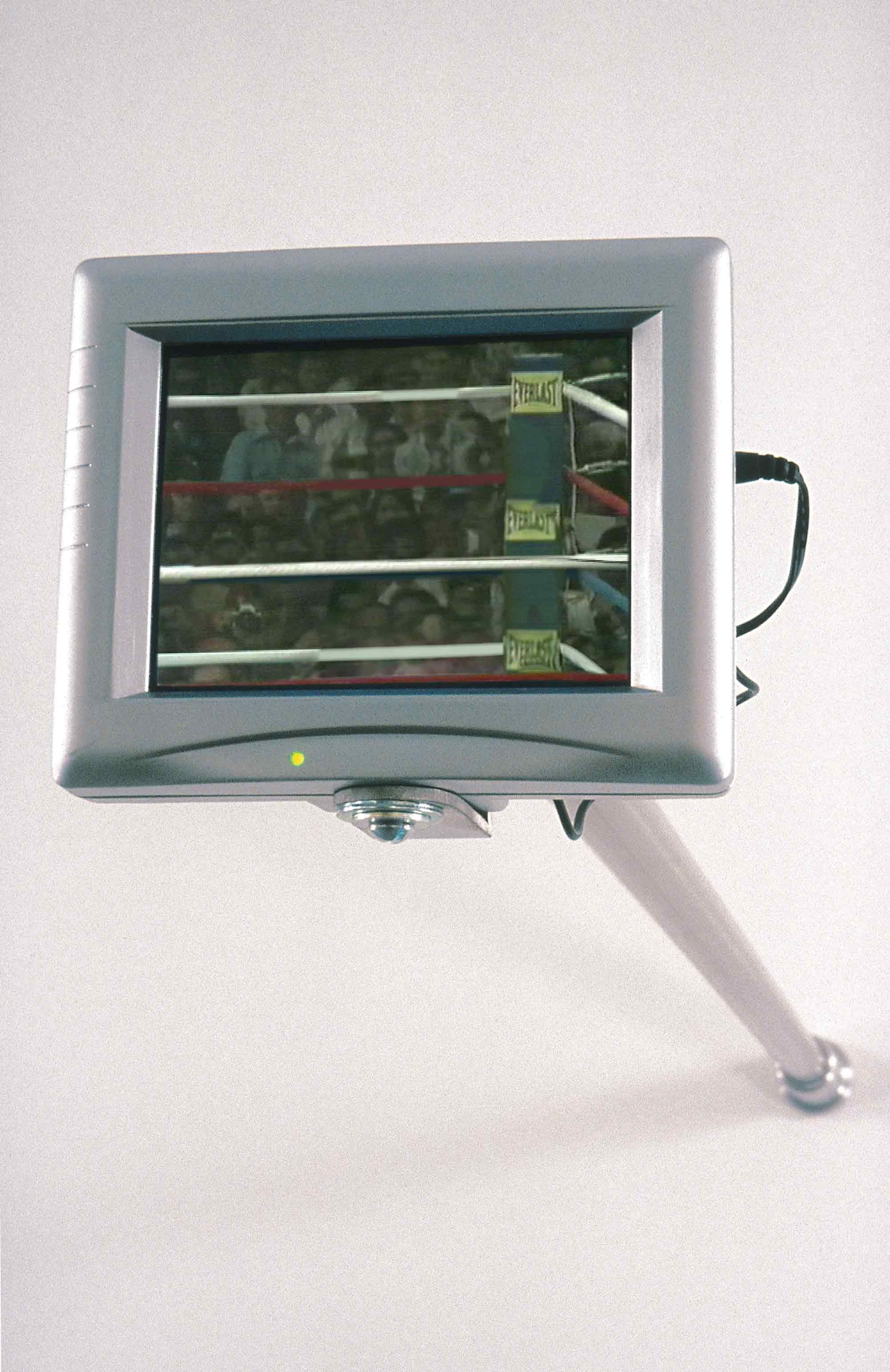
PP: Certainly, to me, there is an inherent association of spectacle with cataclysm, as in “shock and awe.” I like your reference to the flow of change, so this would be a change so big that it disrupts the continual change that we associate with nature and the natural. There is something almost unnatural going on, and that’s what makes me think it’s cataclysmic. But then to miniaturize it is somehow to play with the scale association of the cataclysmic. It seems contradictory to display this—as in the scene of a crowd with flashing lights in The Long Count—at such a reduced scale.
JT: Right. But then, as we know, our ultimate modern cataclysm, the nuclear bomb, absolutely collapses these orders of magnitude. I’m going to turn to Heidegger here: this is an event in which the “increasingly small” becomes fatally conflated with the “gigantic.” As he writes in ‘The Age of the World Picture’: “everywhere and in the most varied forms and disguises the gigantic is making its appearance. In so doing, it evidences itself simultaneously in the tendency toward the increasingly small. We have only to think of numbers in physics. The gigantic presses forward in a form that actually seems to make it disappear…”
PP: In some ways, both the miniature and the monumental have a specific relationship to human scale. The magnitude factor has to do with a sense of going beyond human perception and human scale.
JT: Would you agree that there’spossibly a religious overtone to that word, cataclysm?
PP: You know, that has to do with my own background: the draw of texts, phrases, words and names from the Bible, from religious literature.
JT: Cataclysm is a word that is biblically linked to the flood. It might also be related to apocalypse, which doesn’t necessarily have such a negative reading in religion, right? Because the apocalypse brings about the moment of truth. There’s many people who are praying for the apocalypse; they’re awaiting it eagerly. So, this might be another way to frame the argument. We began by discussing the cataclysm of the merger of the minuscule and the gigantic in terms of scale, but another way to think about it—and here again, I’m returning to The Long Count—is that it serves to collapse the distinction between performer and audience, or between the one and the many. When the energies of the crowd are channeled into that singular figure—which is what your video suggests to me, or a process it highlights—then we have the cataclysm of a kind of de-individuation.
There is something sinister about the way that this happens in your work, but then it also suggests that, to some extent, people want to renounce their individual contours, their wholeness, or, as we’ve discussed it elsewhere, that one-point perspective that holds the subject together. So, what more can we say about the crowd, crowd formations. You’ve brought up Canetti in this regard…
PP: … I was going to turn to Canetti! As you know, he starts his book Crowds and Power by describing how, to understand the crowd, you first have to understand that we live in a society that has a set of normative protocols that prescribe what is known as personal space. People have agreed to a set of relations in which we maintain a certain distance one from another. It’s part of a mode of socialization that gives respect to individual identities, and therefore also involves a kind of necessary maintenance of boundaries between individuals. You don’t go around just arbitrarily touching or interacting with other individuals without asking for permission. So, if you think about that as the background rule that day-to-day life in society observes, then the crowd appears as this state of exception in which people enter into a very different condition with others, or in which people choose to gather and get as close to each other as possible. Psychologically, it presents a kind of release-valve moment in which all of these rules and laws to maintain individual distance and separation from others—which really are property relations, as in, “This is my body and this is my plot of land”—all of these conditions are reversed. When one goes to the stadium, or any other mass formation in which you choose to become a part of the crowd, what is happening there psychologically, as Canetti describes it, is based on a need, like in a moment of carnival, to just release all of the tension of that separation by coming together, doing the opposite of what’s been prescribed, losing that sense of individual identity, abolishing all space between one and another.
JT: In the book Male Fantasies, the author Klaus Theweleit sketches out a dialectical opposition between two crowd formations. On the one hand, the individuals that comprise the crowd unite in an orderly way, which he terms a ‘molar body,’ a single body. In the other formation, which is chaotic, they become a ‘molecular body,’ meaning that all parts of this formation are subject to disjointed, Brownian motions. But, equally, both partake of this desire that you’re talking about, which is partly a transgressive desire, to break through the order of personal distance that defines society. These are possibly two sides of the same coin. I think about the figures in the stadium that you’re dealing with: to some extent, their apartness from each other is being regulated by an architecture that’s ordered and controlling. But that crowd can always erupt. So, there’s always the potential for a molecular body to emerge from a molar body. There’s an inherent volatility to any moment when people are brought together so closely. The many unite, they become one, but this is a precarious construct because the one always threatens to dissolve. I’d say that both operations have to be factored into the transgression that the crowd indulges in.
PP: I’m thinking about how this literature regarding the crowd is associated with the 20th century, and how it relates to the evolution of modern subjects. And the modern subject, for me, is a phenomenon construed in relation to notions of the modern nation state. These things relate on a common-sense level and also theoretically. Like relatively simple geometric forms, the individual and the nation state can be seen as nested, scaled versions of the same thing. So, generally, at this point, my impulse is to think in terms of periodizing the modern subject and the modern nation state. When we invoke the crowd in 2025, we’re not really talking about the 20th century crowd, on which we have this rich literature. We’re dealing with a different animal.
An intuition, I guess we could call it, has led me to emphasize a religious element in the work, whether through titles or pictorial references. And this comes in response to this literary lineage, a kind of study in which there is an assumption of a general movement associated with the modern towards a secular, rational view of things, and away from a specifically populist form of religion.
JT: There’s a ‘mutually constitutive’ relationship between the one and the many within that whole modern scheme. You’re right, this is a language that you find in all the philosophical tracts that make up our modernity, particularly the 20th century version of it. And within that literature, the crowd appears as something like the antithesis of rational, enlightened modernity. In the relationship between the one and the many, or the individual and the crowd, there is a kind of echo of the relationship between consciousness and the unconscious. The lure of the crowd could also be defined as the lure of the unconscious, a renouncing of consciousness that’s also part of the transgressive desire that brings everyone together.
PP: Right, and because of the real events of the 20th century, there’s even a kind of death wish associated with the renunciation of individual identity.
JT: Yes, and that also describes the impulse behind camouflage, as Caillois defines it. It comes down to an “instinct of abandonment,” as he as he puts it, a letting go, and this relates to the death drive. He doesn’t spell it out but, clearly, it’s working on his thoughts. What’s interesting about this text [‘Mimicry and Legendary Psychasthenia’]—which is so cryptic and seemingly so detached from its context of production in a historical sense, almost a kind of non-sequitur—is that it was written in 1934, and once you know that, you start to relate it to all the social changes taking place in Europe, in France and in Germany, right around this time. This is really the beginning of the Third Reich, and so this discussion of crowd formations, the relation between molar bodies and molecular bodies, is, I feel, playing on Caillois’ descriptions of mimicry and camouflage in that text. On the one hand, there’s the mimicking of the singular figure of the leader in the crowd formations taking place at the Nuremberg rallies. But, on the other hand, and at the same time, that crowd is perhaps eagerly anticipating the moment when it can run riot through the streets and wreak havoc. I also think about that in relationship to the Trump rally that then led up to the capital storming. It’s always a two-sided proposition: both order and chaos. You’re both obeying orders and wilfully renouncing consciousness to enter the black hole of the drives, and that’s where you’re allowed to indulge in all that’s usually repressed in everyday experience.
PP: In a way, this is the ultimate stake in the critical tradition, right? And it becomes so intriguing at this moment in history, when we periodize the 20th century version of the modern and as we move into a territory where these inherited categories of critical thought start to become shaky. Certainly, this has to do with technology and the popularization of tools that allow us, to an alarming degree, to really entertain these maybe archaic tendencies that predate and are antithetical to the 20th century ideal of rationalism and citizenship. So, there’s simply this sense that the kind of teleological progression towards the perfection of a form of modern identity might not be as linear as we hoped. I would argue that that structure of linear time—almost as a prerequisite for the maintenance of the sense of a working modern subject and social system—is something that no longer makes sense in relation to what we’re experiencing.
The reality of social media, to me, has to do with the creation of bubbles, which drive people to the most extreme versions of their beliefs and also lead to a total expansion of blind spots. Because you just can’t tell to what degree the information you’re getting is simply the algorithm feeding you what you want to see.
JT: I’ve got a last point to make about the relationship between the one and the many at present. So, daily we are brought into contact with millions and maybe billions of others via the internet. We each have our own unique profile online and this is continually being refined, brought to a point of hyper-individualized distinction. At the same time, however, this profile is correlated with every other profile that it could possibly resemble. Online, we are connected to shared points of interest that have been data-mined from countless other people who are like us. Here, then, we become somewhat like those schizoid figures mentioned in Caillois’ essay on mimicry: figures of absolute similarity: “not similar to something, just similar.”
PP: “Just similar,” which is the definition of the schizophrenic.
JT: Yes, and that’s another point of cataclysmic convergence—in this case, of a kind of hyper-individuation and total dissipation. Your work Vitruvian Figure (2008) is speaking to this phenomenon as well, isn’t it? We discussed the mutually constituted relationship of spectators and spectacle, but here we are left to consider the mutual eclipse of the two.
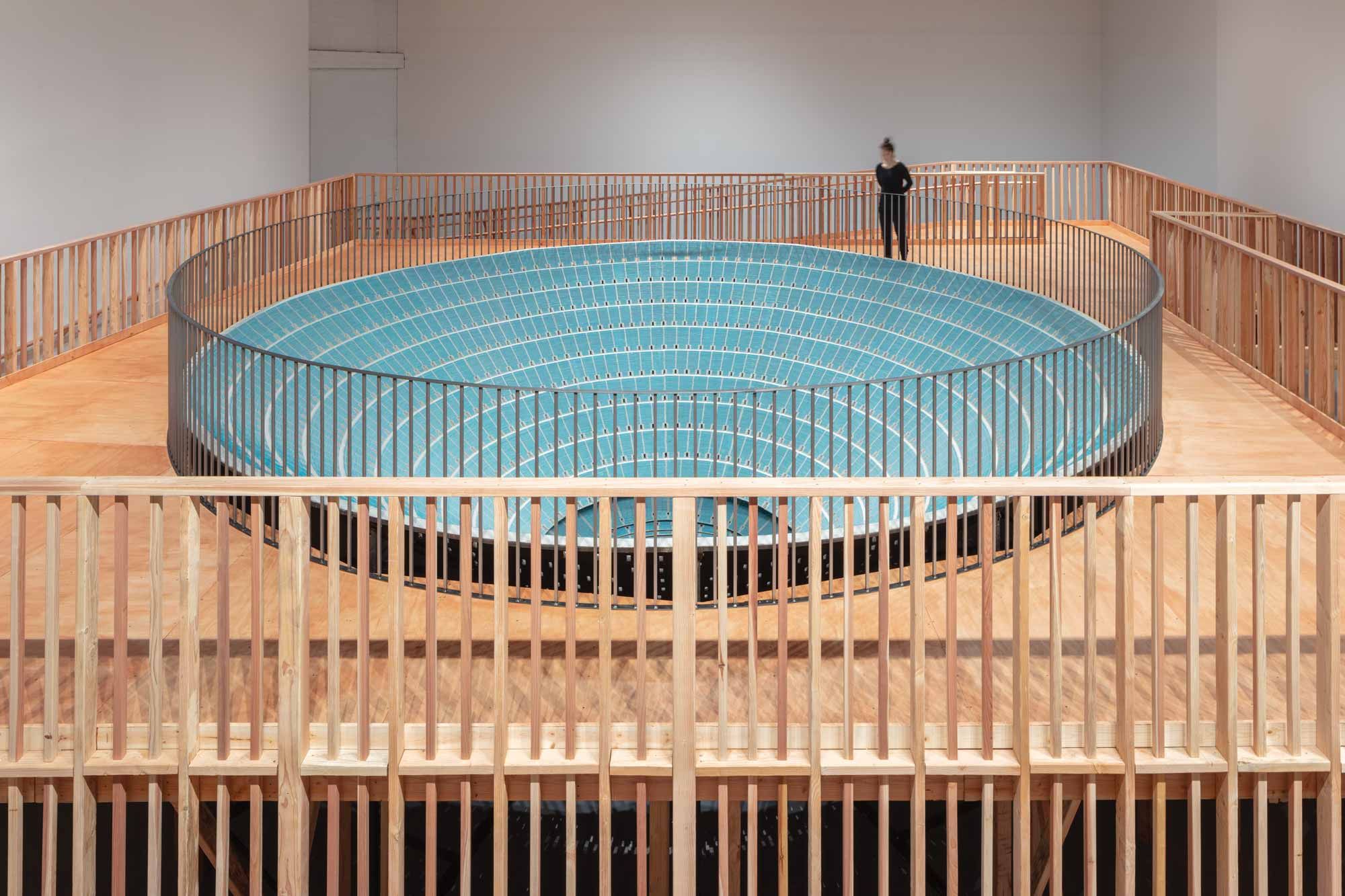
PP: The architectural form of the stadium is something that I intend to use purposefully. As a model for a one-million-seat stadium, what Vitruvian Figure is meant to do is to create a form that is somewhat different from what we’ve been describing. In the 21st century, the crowd is not defined by the stadium, actually; it’s defined by social media. The atomized crowd is what’s definitive of the mode of production we’re in now. The productiveness of the stadium, for me, has to do with its familiarity. It’s a way of describing a condition that goes largely unseen because it’s so hard to imagine. Its atomization makes it so hard to imagine, but we can intuit it through the image of million-seat stadium. What it means is open to question, but, to me, a million-seat stadium is still related to The Colosseum—exponentially larger, but still the same form.
JT: It’s a kind of a metaphor—isn’t that what you’re suggesting? It’s a stand-in, a figure for something that actually is intrinsic to our 21st century experience. Is that related to what I was just mentioning—this notion of becoming similar
PP: Well, I guess I want to come back to the notion that what our inheritance is about is a very specific idea of the modern subject that aligns with the modern nation state and that has to do with citizenship. What interests me is a kind of psychological structure. As much as the 20th century is defined by the rise of nation states and the idea of one’s citizenship, there’s always been this counterpart to that. There’s always been substantial numbers of people that haven’t had citizenship. And, of course, the modern nation state is only made possible through processes of colonization and subjugation. There’s a formative act of violence in the equation of the modern subject that absolutely is driven underground, into the unconscious, because it’s so traumatic. And, at the same time, it is formative. I’m thinking of that in relation to how the world looks now; if anything, the tense relationship of citizenship to, say, flows of refugees is only becoming more extreme. The very maintenance of the notion of citizenship as normative, and the whole psychological inheritance that comes with it—as much as it remains the aspirational goal and therefore the assumed figure of the normal—I think that that could be really contested. So, whatever it is that’s happening to us has something to do with the return of a repressed that’s been there throughout, as a formative part of the invention and promotion of modern citizenship. It’s there in its social foundations.
JT: So, here I’m going to try to very forcefully, and maybe obnoxiously, take the discussion back to the point of departure, to talking about holes. I’m going to suggest that we could see your Vitruvian Figure as a massive hole. Or maybe I should ask: do you see it that way?
PP: Well, it definitely looks like an eye.
JT: It’s not a convex, but a concave eye, right? You’re looking deep into something, like a very deep well. That’s how you’ve set up the view. When you’re positioned at the top row, or even above it, which is where you invite your viewers to be—we walk up that ramp and then stand in a circle around the rim of this arena—from there, you can really imagine the whole spectacle disappearing, funneling away into nothing.
PP: Yes, absolutely, it’s meant to be a hole. In a way, it makes me think about a black hole—or, at any rate, about a hole being a kind of aperture, like a doorway that goes somewhere else. In a general sense, what that hole responds to is an idea that, in any given moment in time, there’s a kind of normative reality at work, like a fabric of normalcy. The hole is a kind of space of exception that, intuitively or otherwise, serves as a reminder that there’s limits to the kind of perceptual vehicle that we’re dealing with. It’s a reminder that what’s out there is not limited to the things that are perceivable.
JT: It seems that you have an ongoing interest in all these various but overlapping forms of architecture. The temple, the sports arena, the concert stage—these are structures that organize a public around an event. I’m thinking that initially, perhaps, this space was just a circle drawn in the sand with a stick, which produced a delimited space, set aside from the business of everyday life. This is a space where things are made to happen that are important and even portentous, things to be memorized and periodically recalled and repeated. In all the architectures that you invoke in your works, this basic structure reappears. It makes room on the earth for what is not of the earth. The ground has been consecrated, rendered holy—which is another way we could talk about holes. We often visit these spaces on holidays, holy-days, which are a kind of hole in time because they have to do with a pause in our workaday lives and also with this injunction to repeat something on a yearly, monthly, or weekly basis. So, here again, we have a cut and a splice, and we have repetition, a loop. This might invite a discussion of religion as a rudimentary form of memory technology, a kind of software supported by an architectural hardware. I wonder if you see it that way?
PP: Well, there was a particular moment in which a kind of general and maybe intuitive interest in classical architecture led me to pick up books on the subject. I guess it was an interest in the far-away-ness of these ancient forms that led me into a kind of personal study of [Rudolf] Wittkower and others. I was curious about the discourse around these forms and about where they come from and what they mean. And one unexpected thing that immediately came out of this reading was the idea that there was a set of proportions that were the basis for the interpretation and the creation of architectural forms, and that these mathematical proportions—the golden rule and so forth—were a kind of base-set of relations that pervaded everything. Not just architecture, because the same principles would be used in classical music, composition in painting, etc. But the original treatises on architecture that survived to this day were mainly intended to function as manuals on statecraft. They were written by architects who were also philosophers and members of the court, and they were meant to educate future rulers on the nature of these sacred geometries that could be used in architectural construction but also the planning of cities and societies, social relations on every level. The importance of these ratios and proportions was that they could align everything man-made with the natural order, all of which is descending from above—you know, from God. So, there’s this idea that to then play with these forms and these ratios, and to bend them in various ways, would be to engage with a kind of fundamental wiring that, whether people realize it or not, constitutes a nested order pervading everything.
JT: A natural order, right, but, in themselves, these forms are of course profoundly unnatural in that they are always pointing towards an ideal that can only be located in religion or in politics.
PP: And also, obviously, to this day, in civic buildings and on facades—not just in the West where these ideas supposedly originate, but around the world—the same sorts of classical structures are used to represent a sense of order in society. So, they’re constantly being inherited, picked up, and readjusted to the order of the day.
JT: And the particular structures that show up again and again in your works are the ones that organize a public around an event of some sort, whether in a circle or a semi-circle. They organize a public around something that then happens, and that happening is absorbed and memorized so that it can be somehow repeated, with regularity, into the future. At least, that’s what I think about the architectures that you engage with: they are memory technologies.
PP: I love the association with memory. I do think that what we’re speaking of is an alignment of thought with a larger pattern that constructs the sensorium in a way. That, to me, speaks to the repetition of the pattern as memory itself.
JT: So, these architectures that are designed to promote repetition are themselves repeated, all of this in service to memory. But then, in Vitruvian Figure, for instance, this architecture is reaching such gigantic proportions that whatever it is within it that is to be memorized funnels into the distance and begins to disappear.
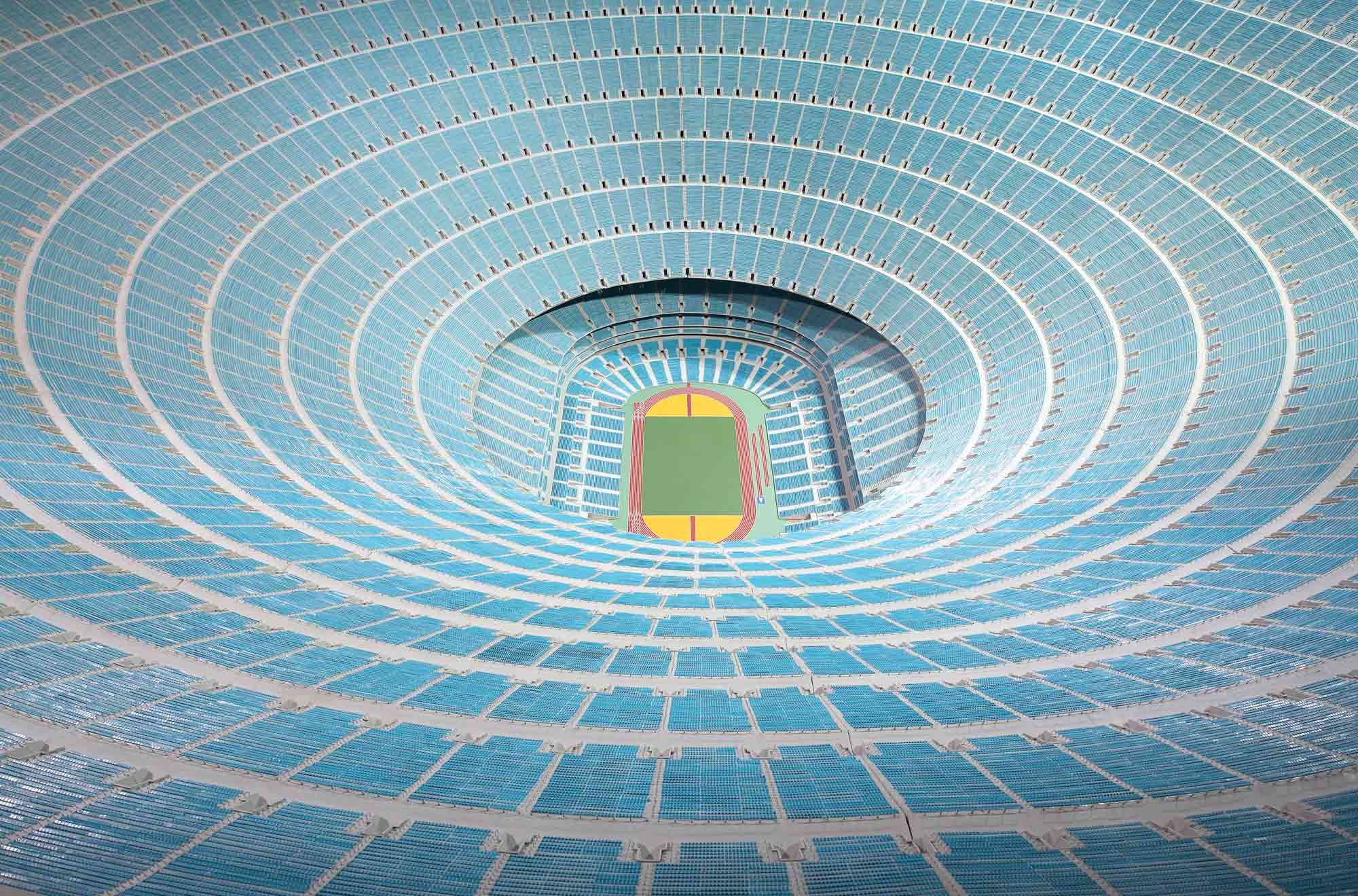
PP: One of the historical precedents for the million-seat stadium is that it was a dream of Hitler’s. Apparently, his architects tried to convince him that it was absurd and got fired for it. If I’m not mistaken, it was Albert Speer who gave him plans for it, although it was never built. So, yes, there’s something cataclysmic about the idea of a million-seat stadium.
To my mind, there’s a relationship between Speer’s arena and what has actually come to pass with mega-churches. For instance, there is a temple in Thailand called Wat Phra Dhammakaya, outside of Bangkok, that is built to hold a million people for mass meditation events. Like most mega-churches, it has garnered a lot of controversy related to the financial backing behind this operation. But it literalizes in an architectural form the idea of a gathering of a million people for a ritual function.
JT: There’s something cataclysmic, yes, about the gigantic scale of Vitruvian Figure. But one of the most surprising moments I experienced in your show was when I realized that this gigantic thing, which is certainly the biggest piece on view, is actually a miniature. It’s an obvious thing to say, but then it’s also almost impossible to grasp conceptually.
PP: The familiarity of the architecture but expanded to that degree and then again contracted…
JT: … It’s a pretty straightforward proposal: what if we increase the scale of this arena to the extent that the spectacle itself would just disappear into the vanishing point. It’s an idea you can easily articulate in words, but then it produces an effect where you’re left tongue-tied.
PP: You know, I did work on this piece with the architects in Australia who built the Sydney Olympic Stadium. The design of Vitruvian Figure was taken seriously in terms of keeping to the mandatory codes of safety as well as visibility. The proper rake of the angle of view to the field is maintained in this model, and the number of entrances and exits that would be mandated for safety is also maintained. So, in a way, this is a very straightforward practical exercise, although, from the beginning, a kind of absurd one.
I don’t know if you’re aware of this, but over the last couple of years, images of this piece started to circulate online, mostly through the ESPN Twitter feed, and a lot of people were really outraged by it, because it was taken as a literal proposal. So, there’s tons of hilarious commentary…
JT: … That’s another form of a loop; in this case, a feedback loop.