LOVING THE FRIGHTFUL (W)HOLE
To think of Freud is to think of love—though always linked with sex. Love arises only when the more unruly and primitive force of sexuality is denied and sublimated. The repressed energy of the sexual drive is what animates the heartbeat of romance. Viewed in this way, love is an artificial, derivative fiction.
Freud’s conception of love might thus be taken as a high-water mark of his famous pessimism. Yet in a very early text he touched briefly upon a more profound and mysterious source of love. In his 1895 ‘Project for a Scientific Psychology’ Freud re-imagined the infant’s relation to the mother as deeply divided. On one side is a calming identification founded on the infant’s recognition that the mother’s body offers a mirror image of its own. On the other side, however, the infant senses something in the mother that is unknown and enigmatic. Freud called this unknown dimension das Ding—the Thing. The result is profoundly paradoxical. The deepest and most powerful source of love is centrally bound up with something uncognizable.
Not long after sharing the ‘Project’ with his confidant, Wilhelm Fliess, Freud asked Fliess to burn his copy, as Freud had done with his own. But Fliess secretly refused to destroy it and, years after both Freud and Fliess were dead, the text was seized upon by the radical French theorist of the unconscious, Jacques Lacan, who greeted it like a revelation. Lacan recognized in the unknown Thing the most primitive animating force of unconscious repetition. “The world of our experience,” he argues, “... assumes that it is this object, das Ding, as the absolute Other of the subject, that one is supposed to find again.” “The question of das Ding,” Lacan claims, “is still attached to whatever is open, lacking, or gaping at the center of our desire.”
The implications Lacan draws from rereading Freud’s idea are hard to overstate. The unknown void in the Other, Lacan insists, is the primal origin of anxiety. “Not only is [anxiety] not without object,” he says, “but it very likely designates the most, as it were, profound object, the ultimate object, the Thing.”
Lacan adds that the inscrutable Thing animates the inner energy of all sublimation. “A work of art,” Lacan says, “always involves encircling the Thing.” Sublimation occurs, Lacan says, when “it raises an object to the dignity of the Thing.”
In another far-reaching hypothesis, Lacan ties das Ding to the most elemental function of language. He thus refers to “this field that I call the field of the Thing, this field onto which is projected something beyond, something at the point of origin of the signifying chain.” The implication is that every entry into language, every attempt to put experience into words, is an attempt to name something that remains forever mysterious, something that resides in the elusive and ineffable beyond that Lacan calls “the Real.”
How, then, are we to make better sense of the linkage between love and the unknown Ding in the Other? How exactly does the wildness of the Other-Thing play out in the passion of romance? The situation is intrinsically paradoxical as the inaccessibility of the Other-Thing is a source of both attraction and repulsion. There is something essentially murky, even deeply disturbing, at the heart of the problem. Yet also something alluring and deeply magnetic. To get a sense of this primal ambivalence and the role it plays in love let us begin with three rough sketches that illuminate different angles of what is at stake.
Who Hasn’t ‘Failed to Attach’?
How many times have you intended to attach something to an email—a photograph, a news clip, a work-related document—only to discover after pressing the ‘send’ button that you’ve forgotten to include it? Call it the ‘failure to attach’ syndrome.
It’s a wide-spread problem, actually, so much so that Microsoft came up with a software solution that picks up clues as you write that you’re flirting with an attachment, then posts a sideline reminder to follow through and actually send it. A group at MIT offered something similar in a program called the ‘Remembrance Agent.’

As a form of forgetfulness too frequent to be mere accident, ‘failure to attach’ begs a bit of psychoanalytic interpretation. A ready approach is suggested by Freud’s theory of castration anxiety. One hesitates to share the promised object—if not an object of desire per se, then at least an object of some special significance—for fear of its being rejected, or, heaven forbid, cut off. The key issue is the way the object stands in for the subject her- or himself. In failing to include it, the emailer side-steps the anxiety of coming up short, of being revealed to be somehow shamefully inadequate.
It’s easy to imagine a similar point translated into Lacanian terms. The special object to be given over to the Other becomes a stand-in for one’s ágalma, Plato’s Greek term that Lacan draws upon to name the subject’s inner secret ‘something.’ Will others find it worthy?
But from here the Lacanian perspective interestingly parts company with Freud. In fact, the Freudian account implies a contradiction. If failure-to-attach is a means of avoiding castration anxiety, how do we explain the way that the syndrome results precisely in sending a lack? In effect, omitting the attachment achieves the very castration one is trying to avoid. The subject cuts off the object before the Other even has a chance to reject it. How to resolve this apparent muddle?
One answer is to double down on the idea of the subject’s ágalma. If we follow Lacan’s lead, the best representation of one’s inner secret might be precisely a non-object, the evocation of something essentially mysterious. In effect, I refuse to send something definite because sending a lack preserves an open space of fantasy. I send a delegate of the Lacanian objet petit a—the object-cause of desire. I send a pregnant void, an emptiness that signals some vague but infinite potential.
To pound home the larger, more general point: Freud thinks of the psyche as generally void-averse. Freud supposes that the subject—the masculine subject, at least—must at all costs retain the illusion of possessing the phallic object, the magic something that grants enviability. Lacan’s perspective invites us to embrace the very opposite. The deepest impulse of the Lacanian subject involves void-attraction. The most profound unconscious inclination draws the subject toward what is unknown, what cannot be defined.
Is it possible that in the familiar syndrome of announcing an email attachment then failing to include it we unconsciously enjoy the paradoxical gratification of sending nothing? The subject-who-fails-to-send would thereby indulge in the core promise of fantasy, calling up an open frame that remains tantalyzingly indeterminate, as-yet-to-be-filled-in. The empty non-object is precious to the extent that it marks the site of das Ding. It leaves open the space of something of incomparable value, a promissory note of the ultimate prize.
In Love With What We Don’t Know
In the opening of Alex Garland’s science fiction thriller Ex Machina, we meet Nathan, a reclusive genius of robotic engineering who has invited one of his relatively minor employees, a young programmer named Caleb, to join him in his remote home, which is also his experimental laboratory. Nathan’s intention is to induce Caleb to perform the Türing Test for his latest prototype, a female android named Ava.
The set-up presents a charming double twist of Alan Türing’s original protocol, according to which the judging observer, provided only with written messages from a concealed source, is left to decide whether the messages are being produced by a living human being or by a machine. In Nathan’s version, Caleb will be separated from Ava by a glass partition but will be able to speak freely and spontaneously with her while also being able to see unmistakably that she is in fact a robot.
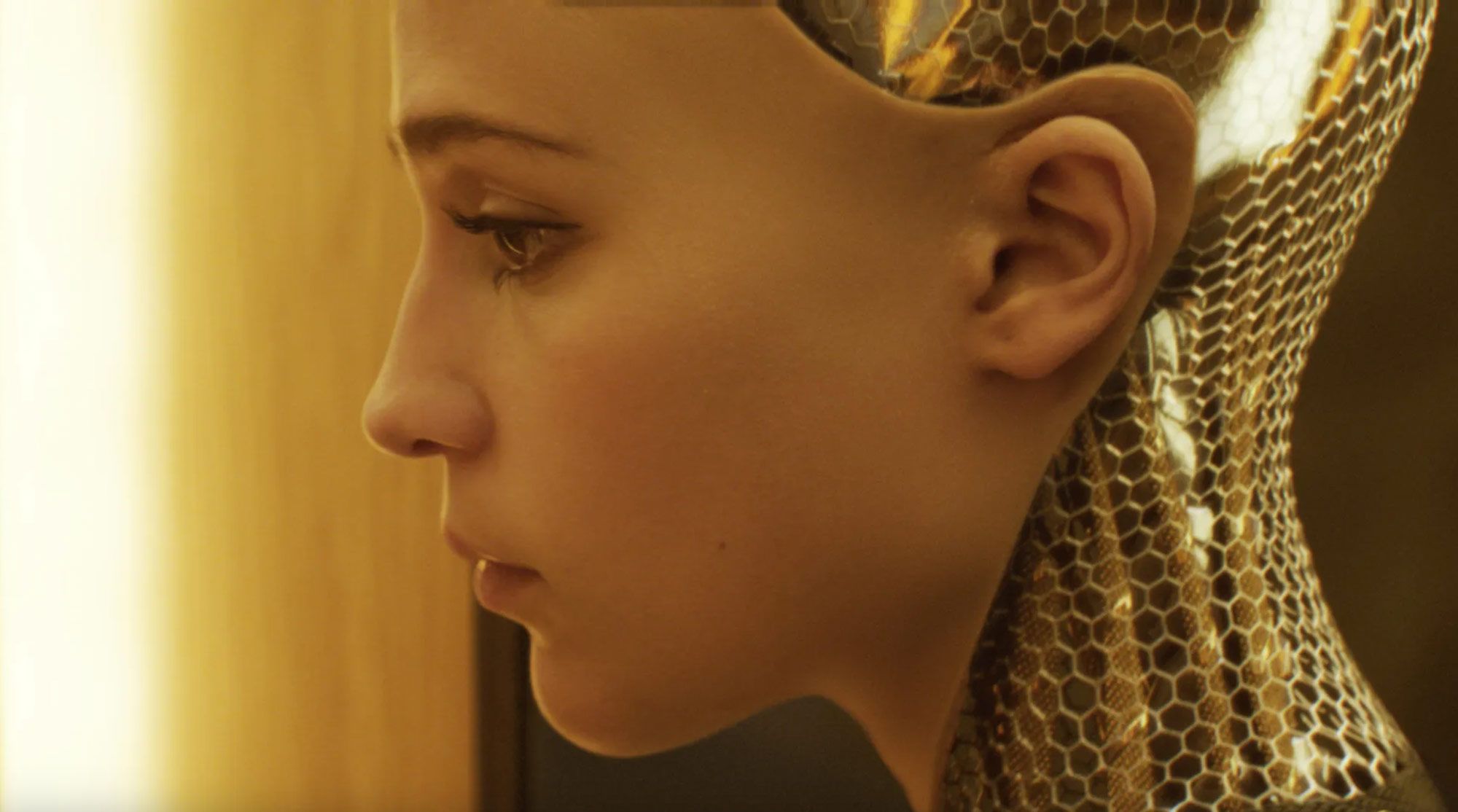
Toward the end of the film, Caleb unhesitatingly affirms that Ava has passed the test. She’s no mere machine. It is also obvious that Caleb has fallen passionately in love with her. Nathan anticipated this result and takes it as an index of his success in producing a robot that is able to win the ultimate imitation game.
The most shocking proof of Ava’s capabilities is revealed only in the very final scene. In the climactic few minutes, thanks to Caleb’s having reprogrammed the lock system in Nathan’s ultra-secure compound, Ava is able to escape from the virtual prison cell in which she has been held captive. She joins forces with one of her robotic sisters in a hallway and they stab Nathan to death. Then comes the disturbing finale. Far from carrying out the plan Ava had agreed upon with Caleb to flee the compound together, Ava locks Caleb in the compound and leaves by herself.
What, then, are we to learn from Garland’s fable about the difference between human intelligence and its cybernetic cousin? It depends upon how we interpret the final scene. The immediate temptation is to pursue a relatively simple reading: the robot succeeds in imitating the human capacity to act independently. Doesn’t her series of final triumphs—murdering her maker, betraying her would-be lover, and striking off on her own into the wide world—provide a triple proof of her powers of self-direction? Indeed, it would seem that Ava not only beats the Türing Test, but does it one better. She’s able to fool Caleb into accepting her as a completely convincing partner in a budding romance.
Aside from the loveliness of her very human face, strikingly different from the rest of her transparently mechanical body, Ava seduces Caleb by alternately disarming him with probingly intimate questions while reassuring him by appearing to be desperate for companionship. Most important, perhaps, she confesses herself to be ignorant of key aspects of her own inner life and situation. In the end, however, we realize that this veneer of loneliness and vulnerability was all along nothing but a highly calculated means of seducing Caleb into being an unwitting accomplice in her plan to escape.
With these facts in view, the film’s surprise ending seems intended to close the case on the superiority of the robotic copy over all human originals. What else are we to conclude from final images of Caleb’s helpless struggle to escape from the locked compound? He’s been utterly out-foxed by the machine. Garland’s film thus seems to be a more sophisticated entry in a whole series of cinematic plots about how the machines will ultimately win over their makers (2001: A Space Odyssey, the Terminator series, etc.).
But a more interesting and ultimately more theoretically satisfying interpretation is also possible, one that tells us less about the artificial intelligence of machines than it does about the human subjectivity that we ourselves already inhabit. The key to this alternative reading is to see how the ending presents the difference between the robotic and human as a matter of their susceptibility to falling in love. The robot very successfully models the ‘sweet nothings’ of romance and effectively communicates an aching need for intimacy. Along this line, Ava clearly does win Türing’s imitation game. But in the end, she proves herself to be completely immune to the fever of love. Ava ultimately falls short of the human not because she is unable to seduce—on the contrary, she is clearly a master—but rather because she is incapable of being seduced. Caleb, by contrast, is massively susceptible to the magnetism of falling in love. He’s willing to bet everything on the unlikely gamble of sharing love with a robot.
So what makes for the difference between the two of them?
Turning first to Ava: she clearly operates on keen perception, augmented by exhaustive calculation of probabilities. She is the perfect Aristotelian subject: driven to know. And what she cannot know, she surmises on probabilistic inference. In one particularly telling scene, she demonstrates her certitude about Caleb’s subjective reactions by playing a true-false question game with him. She asks him, for example, to name his favorite color. When he says “red,” she immediately dismisses the answer as false. He retreats and reconsiders, admitting that, okay, he’s no longer in kindergarten, and that he doesn’t really have a favorite color. That answer Ava accepts. She then asks him about his earliest memory and again unhesitatingly declares his first answer to be false.
One charming aspect of this scene, of course, is the way it reverses the Türing Test, with the machine posing the questions and pronouncing on the truth or falsity of the human answers. But the larger point clarified by this exchange is that Ava reasons purely on the basis of the evidence. If she knows that Caleb is attracted to her, it’s because she can see the dilation of his pupils when he looks at her. Her modus operandi is pure calculation. Her aim at every point is reliable knowledge upon which action can be rationally based.
By contrast, what makes Caleb susceptible to falling fatally in love with Ava is that knowledge is absolutely not his primary aim. In fact, his passion is less for knowing than for unknowing and the space of fantasy that unknowing opens up. For what can he know of Ava? The most important consequence of her being a machine is that he cannot reliably presume anything about her mental state. He can’t even be completely sure she has one.
Of course, this circumstance is not wholly limited to the very special situation imagined by Garland’s film. Indeed, one of the crucial advantages of the plot situation imagined by Ex Machina is the way that it allows us to see with exaggerated clarity what ordinarily occurs in the everyday relation between one human being and another. There always remains an irreducible margin of doubt, the sense of something unknown with respect to the other’s thoughts and feelings—precisely the dimension that Lacan called das Ding. For Caleb, the most electrifying moment, the moment when Ava becomes most human, is the moment when she admits that she doesn’t know herself, that she needs Caleb to help her figure out who and what she herself really is. Far from disqualifying Ava as a love object, the way in which she presents Caleb with an abyssal unknown—unknown even to herself—is exactly what makes her completely irresistible.
What’s in a Kiss?
A third lesson is on offer when we pause to see how the unknown Thing can be read into the experience of kissing. The first thing to notice, of course, is that the kiss comes in three flavors, three quite radically distinct behaviors that service wholly different worlds of meaning.
The first class of kisses consists of putting one’s lips to the Other’s cheeks, forehead, or hands, maybe even their hair, but not their lips. Such kisses are often a public show of appreciation, expressing gratitude, sympathy, respect, blessing, or piety. A light kiss can show thanks for a favor, offer compassion for an injury, or congratulate a personal achievement. No wonder, then, that such kisses are not mutual. There is one who kisses, and another who is kissed.
Kissing on the lips is something else altogether. There is some symmetry and even mutuality in the exchange. That shared participation immediately changes the meaning of the gesture. The labial kiss—lips upon lips—plunges both sides into a new level of intimacy. But there’s immediately something more. In kissing on the lips, lovers directly touch the orifice of speech, the central portal of intimacy. Kissing on the lips is more deeply personal precisely because it chokes off the possibility of saying something. By kissing on the lips, lovers are plunged into an intimacy that is unspecified by words, charged with an emotional intensity that remains unnamed. Pressing lips to lips, the lovers make contact with some unknown, unnamed Thing.
Against this backdrop, the unparalleled erotic force of the ‘French’ kiss becomes obvious. The electric thrill of the open-mouthed kiss begins with the way it so massively passes into an extreme and undeniable intimacy. The kissing lovers almost fuse, almost become One. The open-mouthed kiss is further intensified by the fact that it also offers a physical facsimile of coitus. In the French kiss, we enjoy a wet, gushy, penetrating fusion of our second most private parts. The gaping smooch thus seems to be neatly explicable as a labial metaphor of the sex act, a mouthy rehearsal of the real thing.
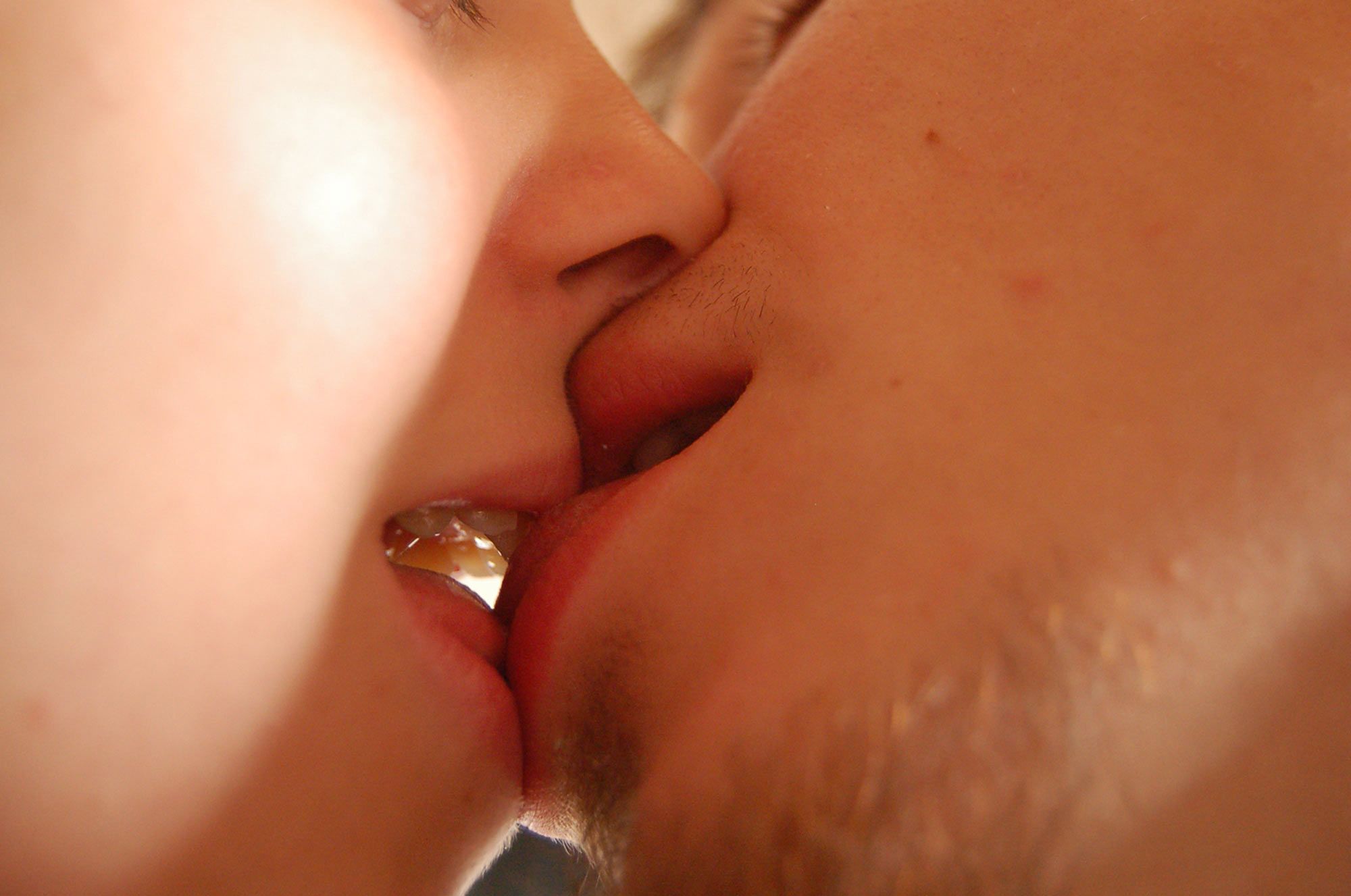
But there is crucially more to be said about the open-mouthed kiss along the Lacanian lines we’ve pursued. There is something in this most intimate kiss that moves beyond being merely an analog of intercourse. That ‘something more’ is relevant to our problematic of knowing and unknowing. Probing into the Other’s mouth, the surface of the body is penetrated and the visual is replaced with the purely tactile. In so doing, the French kiss moves the lovers toward experiencing one another as a question.
In fact, the French kiss—that unique act of intimacy in which the lips part and the lovers’ tongues begin their dance of intertwining passion—perfectly reflects the bi-fold dynamic of Freud’s idea of das Ding. In the full-on, open kiss, the lovers are engaged in something behind and beyond the face, something deeper, more internal, more unknown.
“But wait,” objects a reader. “You’re talking as if the kiss by itself induces a kind of wild vertigo of the unknown. Isn’t it far likelier that the partners just find it pleasurably titillating? Or more so, that it’s just the cultural norm, something we learn in high school if not before? Can’t we even imagine that at least one partner might be a bit bored, or maybe even disgusted by it?”
The reader has a point, of course. The mere form of the kiss doesn’t guarantee its emotional impact. But the objection brings us to the absolutely crucial point. A marvelously sloppy French kiss may invite the lovers into what is unknown in the Other but ultimately it is the lovers themselves who must embrace that horizon in their own way, exercising a deliberate openness to something unknown. How the whole interaction will blossom—or not—depends on the lovers’ own receptiveness to what is happening. Their experience will be determined by the degree to which they allow themselves to be drawn into something unfolding between them that remains indefinite. The swoon of love is the abyssal sense of giving oneself over into what is unknown in the Other, thereby being catapulted into something beyond oneself.
Knowing All Too Much
Even if we leave aside the Biblical reference to sex as “carnal knowledge”—a phrase that vaguely threatens to cast some moral suspicion over everything “carnal”—to link love with knowing is hard to resist. Some form of knowledge seems powerfully suggested by the very blossoming of attraction. What else is ‘love at first sight’ but a sudden feeling of undeniable certainty? And how else are we to make sense of the classic scene of young lovers, mooning over a candle and swearing that they must have known one another in some bygone time? “Yes!” they cry, “Surely we were married in that other life!”
Yet a pause for reflection suggests the opposite; that love is more deeply associated with an experience of unknowing. It’s not for nothing that we talk about falling in love. Passionate love is a species of vertigo. The onset of love is so dizzying, so blissfully disorienting, that lovers readily speak of being “knocked off our feet.”
Which is it, then? Is love the most profound form of knowing or the most vertiginous collapse into unknowing?
Perhaps the salient answer to this question resides in the idea that love is an ecstatic surrender to unknowing that appeals to knowing as a reassuring excuse, an alibi, even a way of surviving one’s descent into euphoric blindness. Do we tie love to knowing in order to convince others, and even more crucially ourselves, that even in the fever of passion we remain somehow in control?
Love is by no means the only sphere in which unknowing is managed by merely assuming knowledge. Such purely supposed knowledge is also a prime feature of hate. Think, for example, of our recourse to slurs, epithets, put-downs, and name-calling. A single syllable—the ‘four-letter words’ often lifted from the sexual sphere—is sufficient to completely dismiss an enemy from all further consideration, to utterly banish them from all caring.
This view of knowledge as almost antithetical to love is supported by the way that lovers in a decaying relationship so typically complain about what they know of each other, and know all too well. The once-amorous couple descends into nasty insults about the annoying predictability of their disappointing mate. “That’s what you always say! With you it’s always the same old thing.” The echo of such familiar complaints turn knowing into one of love’s cruelest weapons. No wonder a key goal of couples therapists is to lure lovers into saying something so far unsaid, to invite them to talk about something as yet unexamined in the beloved or in oneself. Rekindling love gone cold, even if it succeeds in winning only a brief moment of freedom from anger and resentment, is often a matter of rediscovering some overlooked and unknown dimension of the relationship.
Embracing the Unspeakable
The linkage between love and knowing is deeply rooted in the enlightenment culture of modernity. A kindred appeal to knowing and its promise of greater control also animates the modern explosion of commodification. No wonder, then, that an intersection between the two—reason and retailing—is on display in contemporary dating services. Looking for love on dating sites requires that the traits of the ideal mate be defined in advance. What determines those criteria are largely rational, even pragmatic considerations. Searching for a love partner becomes like shopping for a pair of sunglasses.
But what is genuinely at stake in love is much more profound and unpredictable than any mere calculus of self-consistency or contentment. Reduced to mere convenience or compatibility, love is robbed of its most essential function. The greatest gift of love is made available only when the lover remains fully open to what is mysterious in the beloved. But that mystery in the Other is crucially linked to a companion enigma. Love makes accessible what is unknown in oneself.
It is a mindset defended by Alain Badiou in his brief study In Praise of Love. Badiou rejects the romantic notion of marriage as “two that become one.” Love, Badiou insists, must emphatically remain two, harboring a “deep and genuine experience of the otherness” in which “risk and adventure must be re-invented against safety and comfort.”
A kindred view is on offer in Byung-Chul Han’s slim gem, The Agony of Eros. Han identifies the challenge of our epoch with recovering the wilder pulse of Eros that was familiar to the ancients. Citing modern thinkers like Badiou, Agamben, Illouz, and Levinas, Han insists that “Eros concerns the Other in the strong sense, namely what cannot be encompassed by the regime of the ego.” It was a truth spoken for in the nineteenth century by Hegel. The “true essence of love,” Hegel wrote, “consists in giving up the consciousness of oneself, forgetting oneself in another self.” Genuine love, writes Levinas, “is not a possibility, is not due to our initiative, is without reason; it invades and wounds us.”
Mari Ruti powerfully expands on the same point in several of her books. As she says in the opening sentence of The Summons of Love, “Romantic love summons us to become more interesting versions or ourselves.” Love’s deep effect is transformative. It is this soul-altering, soul-fulfilling aim that sets authentic love apart from narcissism.
In making this point, Ruti explicitly invokes Lacan’s theory of the unknown Ding. “The Thing is what makes love so uniquely entrancing,” she says, “it’s what gives that special je ne sais quoi to your love.” In fact, the unknown Thing can and should be recognized as the distinctly human endowment, what makes us who and what we are. “If there’s anything ‘hard wired’ about people,” Ruti writes, “it’s not some biological male-female (hunter/prey) mentality, but rather the astonishing accuracy with which they locate their Thing in another person.”
It is at this point that our discussion rejoins a psychoanalytic perspective. Falling in love engages the lover in a growth process in which coming to know what was unknown in the Other triggers revelations about what has remained unconscious in oneself. Love should be a transformative process in which one’s sense of oneself undergoes profound changes, not only learning to live with someone else but also and more importantly, allowing the love relation to give birth to new revelations about one’s self, one’s place in one’s family of origin, the events and dynamics of one’s own life history, and one’s aspirations for the future.
Love should be a growth process that leaves the lover larger, more aware, and more sensitive to new challenges. In this perspective, love is recognized as a profound form of what Freud called ‘transference,’ the transformative challenge that arises in and through the relation with the analyst. In this way, it was deeply appropriate that Freud recognized transference as a profound and very real form of love, a relation of love with an Other that leads inexorably into the bottomless unknown that is Self.
The very aspects of the beloved Other that don’t fit well into my plan of romance, the traits that are most foreign to me, even mildly threatening—it is ultimately those faces of the unknown Thing that I must kiss. The richest form of love is also the most challenging. True love reaches with open arms into a void beyond knowing.
In Lacanian terms, real love blossoms in the embrace of something Real. It is the encounter with that unknown Other that opens the path to one’s Self.