THE GIFT
One could not be anything but underdressed that lavender afternoon, with Paris in the stranglehold of early winter. Early December, and the gallery bore no heat. He would have just met Kiki fall of that same year; Kiki, who was a nude model for the city’s artists and had been disowned by her mother, though which event led to the other was quite irrelevant by then. They were to live together in a small, one-bed apartment, in an ensuing eight-year relationship. He would come to take pride in doing her makeup as with his work of any other: her drawn eyebrows, her jade eyelids. But today was about him, and there he paused, extremities stiff with cold, amid preparations for the opening, when in walked a pair of quizzing eyebrows stitched into an open forehead. Gesturing, the earnest man whose name was Erik Satie led him from the gallery to a café for warming, alcoholic drinks. Several drinks later, the two returned and he, in a giddy daze, had bought a flat iron from a utensils shop en route. Back at the gallery, he affixed tacks to its base with some mild effort and the aid of some glue. Dark, heavy and lethally pointed, the domestic-object-turned-weapon was placed among the other artworks in the show. Like this, The Gift (1921) debuted.
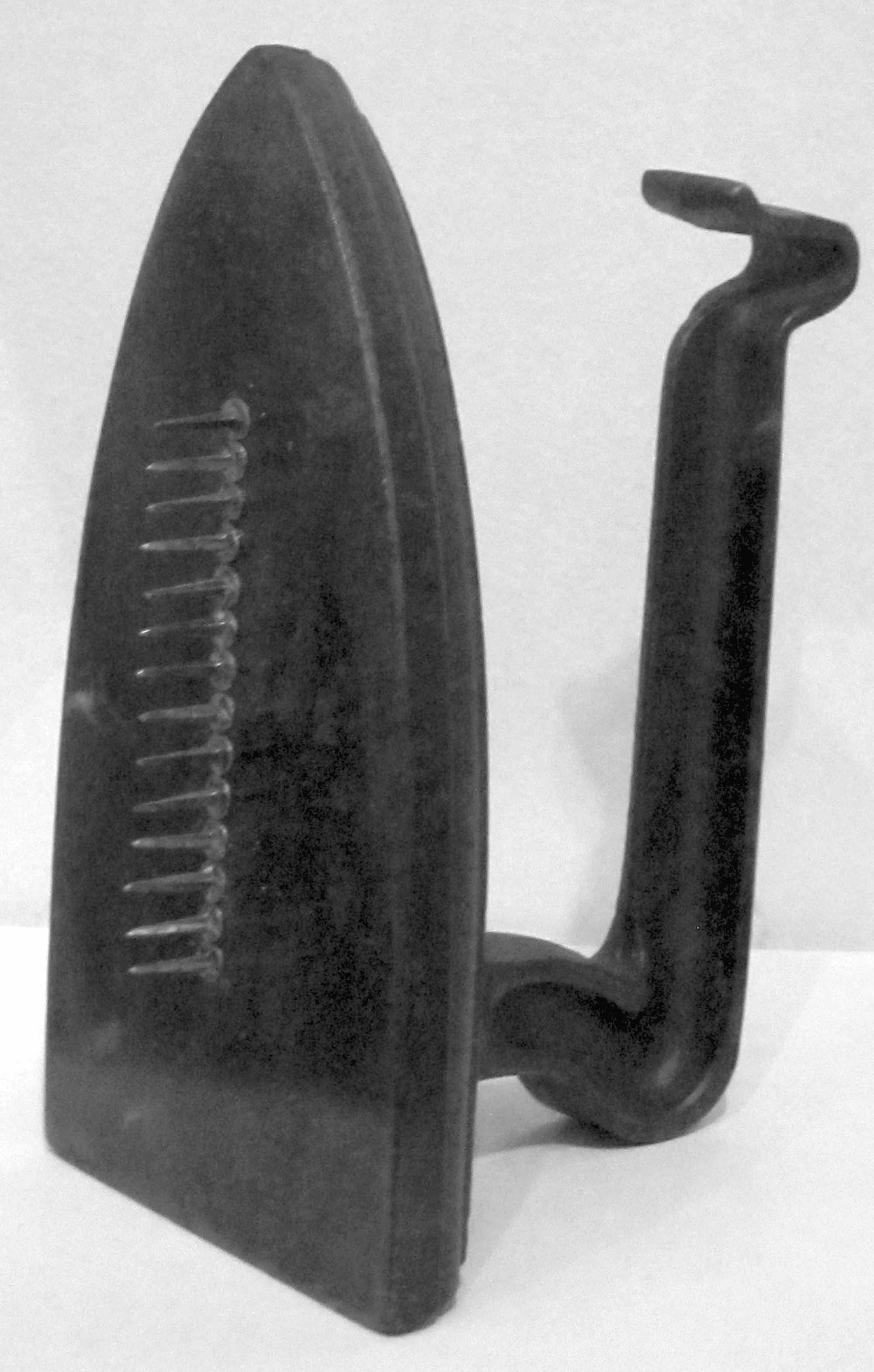
Funny that Man Ray (1890-1976) should title this work “The Gift”. Though a gift it surely was—he intended it for the erudite Philippe Soupault of Librarie Six, at whose bookshop-cum-gallery he was exhibiting—few would consider the sadomasochistic little object one. If merely by titular designation, The Gift coquettishly stages this familiar irony: to be given something one does not want but, by the contract of the gift, cannot refuse. The Gift so enacts a bondage between giver and recipient, one that engages the very stakes of giving and receiving. What’s more is that Ray’s work refuses to placate the recipient in their expectations and instead upturns them entirely, and what is a gift if not that which simply bears the experience of surprise itself? Indeed, history tells us that The Gift elicited fascination, even outcry, among visitors that one lavender evening. This may or may not account for its disappearance from the opening such that, as luck would have it, it was ultimately unable to fulfil its nominative destiny as gift.
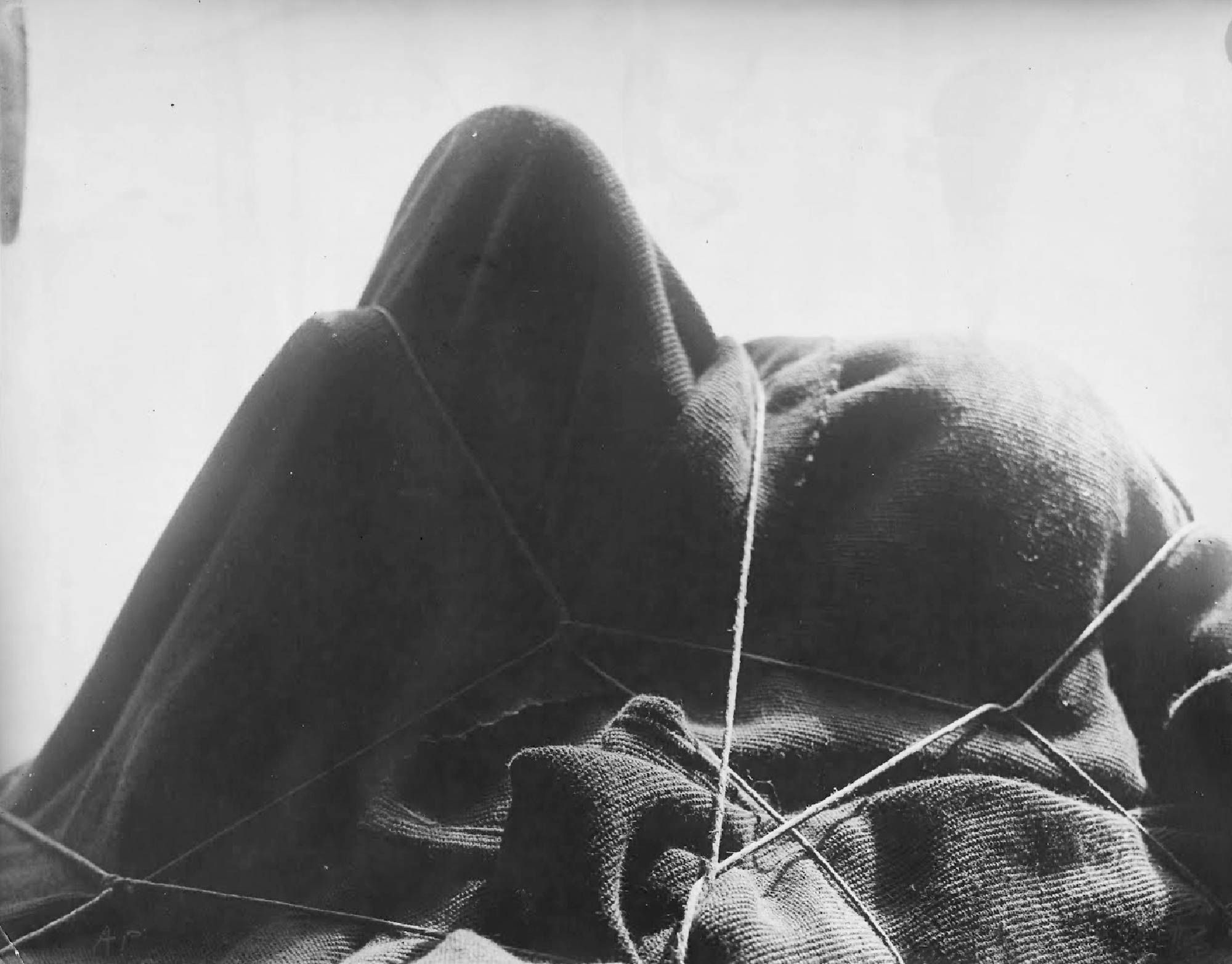
Consider then The Enigma of Isidore Ducasse (1920), which Ray created sometime the year prior. Unlike Ray’s pronged iron, The Enigma traffics in one defining hallmark of the gift, namely, the act of wrapping: the successful adumbration of an object which cannot but suggest something to the imagination. Consisting of a cloth-covered object and some twine, The Enigma involves the device of cloaking, the reduction of an object to a basic formal quality: shape. This shape is, nonetheless, the support for a so-called composition. The materiality of the cloth, rough-hewn, brown and indecorous, meets with the linework of the knotted twine which, travelling the span of the object’s peaks and perimeter, criss-crosses, at points. All this is no more groundbreaking than the work of ordinary people going about ordinary affairs—the person with only simple means for gift-wrapping, or the person that unthinkingly packages up an item for postage or the mover’s van.
Gift-wrapping is a practice borne of the ceremonialisation and theatricalisation of the event of giving; the object undergoes a transformation, in being wrapped it becomes event. But none could mistake The Enigma for the kind of gift we see in commercial circulation today, those with brilliant patterns and elaborate pleats, long silky ribbons. There is reservation here; for all that it hides, The Enigma is frank. Despite its arguable lack of frivolity, Ray’s gesture of wrapping is just as performative. There are at least two simple conditions and effects we can name as being operative: one, Ray’s preparatory gesture heightens anticipation; two, it is a protective gesture that offers the object anonymity and safety in travel. Ray is aware of what concealment accomplishes: the frenetic stirrings that result, the way in which it sends her on travels of the imagination.
This is no work of traditional representation, but nor is it a work of abstraction either (it does not undo an image from within). Giving up the idea of image and object as wedded unity is not an easy thing, and the separation anxiety triggered by the possibility of their divorce is no better described than by Tadeusz Kantor (1915–90). A Polish artist known for his “emballage” works—which translates from French as “packaging”—like Ray, he used the technique of wrapping, noting the effects of doing so: “Then the old wave came back. The time of o b j e c t. / That ‘something’ exists at the opposite pole of my consciousness, / of ‘me’. / Inaccessible. / And the centuries-old striving to ‘t o u c h’it, at all costs.” Only later in Kantor’s poetical reflection does it become obvious that he has set up a parallel between the object as physical reality and the virtual object that is introjected: “The object which was deep inside me / was drawing attention to itself with a mixture of urgency and / promise…” What is critical here is his reference to a non-physical object residing in the psyche and the suggestion, therefore, that even inexact objects of the physical world can intimate something or find relation with its contents. Psychoanalyst Melanie Klein knew this well when she discovered the case of Ruth Kjär, a woman who in the eyes of others could want for nothing, yet experienced bouts of melancholy and was anxiously preoccupied with an empty space on the wall of her home. As Klein observed, the empty space was analogous to the loss of a love-object that had left an unfillable emptiness within her. Kjär later becomes a painter, growing in happiness and fulfilment as she gains the autonomy to create and invent with her newfound abilities, allowing her to fill the empty space on the wall.
So the inverse may be true: there is grave unease in forsaking the object-image as given or granted. As Klein noted with Kjär, the absence or disappearance of an internal love-object can inspire melancholy, depression, even the anxiety of death. No less an object of sadomasochism than The Gift, Ray’s Enigma implicates its viewer in a fantastic psychical relay that draws her closer in bondage—while The Gift presents sadomasochism as its primary subject, The Enigma goes so far as to recreate its mechanisms. For a whole host of complex processes are set in motion in the viewer who encounters The Enigma. There is firstly the sadism of the little felt-and-rope straitjacket, the perversity of offering object thingliness outright, only to leave her bereft of the image. She takes what she can. The object beneath looms strange—know me, find me, it seems to tease, search for me in the gaps of your memories. This plea to the imagination tires her slightly, for every occasion she returns to the strange silhouette, she is sent back to chase the elusive mental image and suffer the inanity of her own grasping. “I knew well that traditional representation, its ‘image’/ would not come back / since it was only a reflection, just like moonlight. / Underneath it is dead. But the object exists.”
What begins as ticklish titillation in time turns frustration, the prolongation of the guessing game masochistically joyous. Were it merely a wrapped gift or packaged post, she would have opened it, but the art object is not only wrapped, it will also never be unwrapped, because artworks are untouchable. The immortal status of The Enigma as art object engenders a profound irreconcilability, a withholding without end. Sadism can be read in Ray’s interceding in the object-image dyad to be sure, but masochism is ushered onto the scene with the duration of The Enigma as artwork. The work of art involves this convention, of seeing separated from touch, of learned restraint. She continues to play by the rulebook of social conduct, though the “rules” of this guessing game are rigged, yielding a contract of a different kind. Staging a confrontation with desirous feelings that are only amplified by the not-having, she is bound in the way that The Enigma is. The concealed object haunts her imagination, she knows not what it is and yet, for all that, in their mutual bondage she identifies with The Enigma. The event of spectacle now holds just as it withholds.
In the same way that some visitor in the opening’s small droves was compelled to steal Ray’s Gift to Soupault, The Enigma arouses such discomfit that it, too, begs intervention. Becoming stranger to herself, she registers the compulsion to violate the laws of conduct that are equally the terms of the display of art, with her secret wish to desecrate it. But what then? The inconvenience of reality hoves into view; as much as dodging museum security to de-cloak The Enigma would be awkward, the desecration of The Enigma bears incredible psychical risk: the possibility of discovering nothing where there should be something. “As though I were afraid to pronounce another word / following closely the word NOTHING – the word DEATH.” And there lurks the murmuration of existential dread, linked to a tension or impasse: an incapacity to deal with unending anticipation that is at odds with the fear of discovering nothing. For stilling the animacy of phantasy is one way of understanding death: what “nothing” is to phantasy, death is to life’s vitality. The falling shadow of realisation leadens an entire suite of feelings, it is complexity directed to a dead-end, life energy stalled and then diffused. The dissimulation of the surprise of the gift always kills the erotism of phantasy, which is also why the orgasm is referred to as the le petite mort. “Underneath it is dead. But the object exists.”
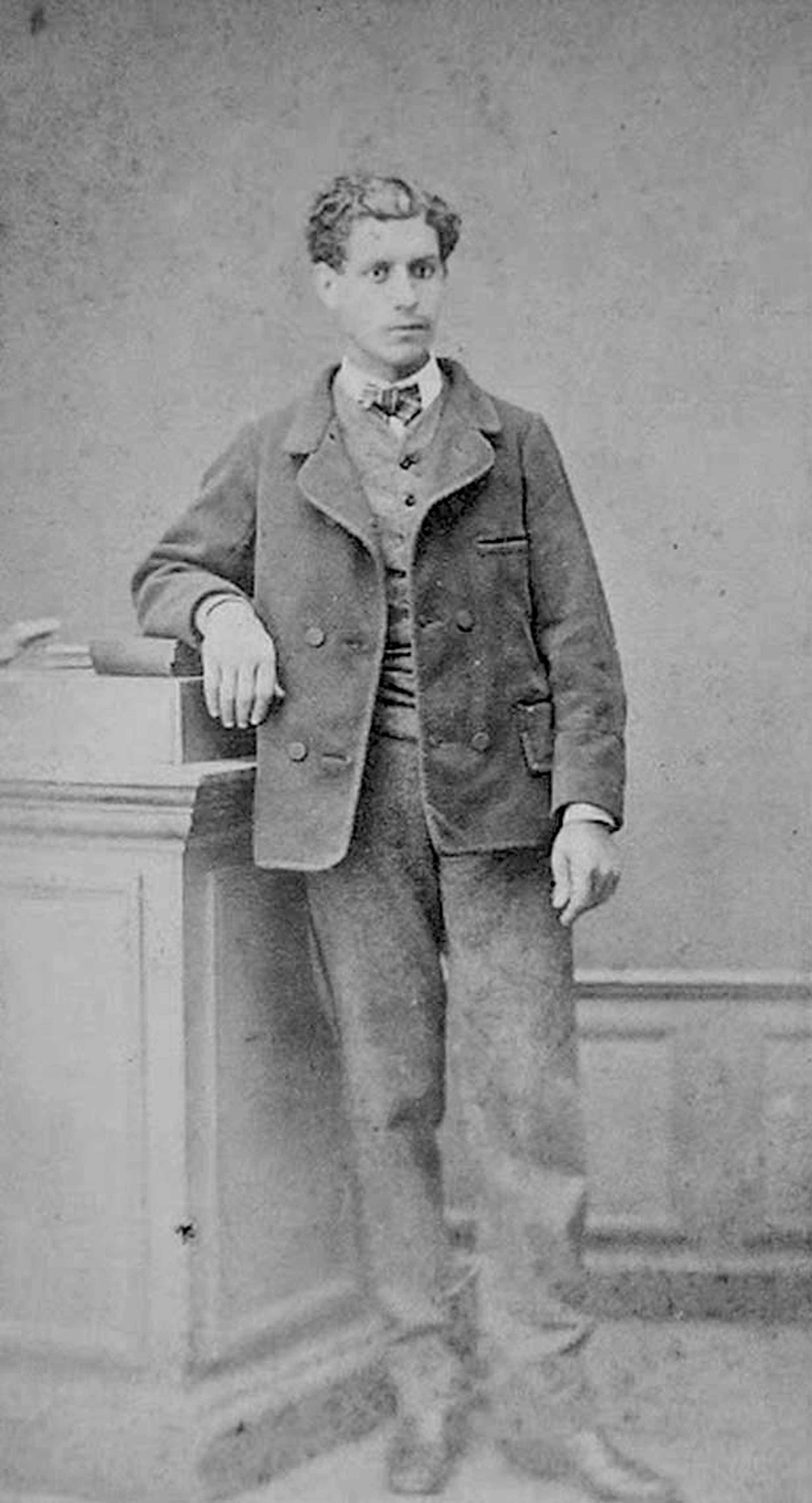
No surprise either that the very condition of not-knowing is what compelled Ray to create The Enigma. The actual object of not-knowing is actively named in its title: Isidore Ducasse (1846–70). Ducasse, whose Les Chants de Maldoror (1868–9) a certain Philippe Soupault had published a version of, and whose dark and deranged writing was to André Breton, Ray’s friend and the Surrealists’ ringleader: “the expression of a total revelation that seems to exceed human possibilities.” Apparently, Ray was given a copy of Les Chants de Maldoror by his first wife, the Belgian poet Adon Lacroix. This was before Kiki de Montparnasse, before evenings of jade eyelids and bitter, scabrous fights. Of Ducasse’s life, affections and predilections, on the contrary, far less is known. Here is one rare account from Ducasse’s schoolmate Paul Lespès: “Most of the time he was rather sad and silent, as though he were folded in upon himself.” And as for the mind seated behind the silence, an inclination to delusional ramblings—“outrages of thought and style”—that perturbed their professor of rhetoric so deeply Ducasse was reportedly punished for it. Ducasse died in Paris in November 1870 at the age of 24, his death certificate having been signed by the hotel owner and waiter who furnished him with his meals. No more than this meagre handful of regurgitated facts, Ducasse was consecrated as Surrealist saint less for being a tragic youth than for the maturity of his foresight, his opacity a wilful epithet personified as follows: “I will leave no memoirs”. Of the Surrealist penchant for figures of mystery and their enamourment with the writing of Ducasse, it is as Roland Barthes asks: “Is not the most erotic portion of a body where the garment gapes? In perversion (which is the realm of textual pleasure) there are no ‘erogenous zones’ […] it is intermittence, as psychoanalysis has so rightly stated, which is erotic […] it is this flash itself which seduces, or rather: the staging of an appearance-as-disappearance.”
It is oft-repeated that The Enigma is Ray’s homage to Ducasse, an expression of admiration for the liberatory, visionary way in which Ducasse composed images from unlike things. The most literal reading of the artwork ends where it begins however, with qualifying The Enigma as a representation of one specific line from Les Chants: “He is as handsome as […] the chance juxtaposition of a sewing machine and an umbrella on a dissecting table”. This is not only the least interesting interpretation, but worse still a de-complexification thwarting the very possibility of unbound phantasy Ray sought to produce in his beholder. Recourse to representation undoes the work, spells death. To understand the cloaked sewing machine as “portrait” only occupies the agitated mind with a plaything. Why is it not equally plausible, if not likelier and truer to Ducasse, that Ray wished to induce the anarchic chaos of imagination, one run wild in the way of “infuriated dogs”, who “snap their chains and escape from distant farms; they rush through the countryside, here, there and everywhere, in the grip of madness”?
But yes, the concealed object is a sewing machine. Pay heed to the deflation that accompanies this knowledge, details that a viewer may have just as easily procured online or from the wall placard in tidy, serif print stating the artwork information, should she care to look. And she did, regrettably—Man Ray; L’Enigme d’Isidore Ducasse; 1920; Sewing machine, wool and string; 355 x 605 x 335 mm. That which once fixated and fascinated is drawn away in the great banalisation of the mystery, a tidily sobering effect, “the objectification of the marvellous”. Note how she has finally succeeded in desecrating The Enigma, yet not by unwrapping the actual object. This is precisely because Ray’s artwork proper exists elsewhere: less the object at hand, concealed or known, than the virtual processes alighting from it. Yes, the concealed object is a sewing machine, but The Enigma is the sadomasochistic relation incarnate; the phantasy that dovetails back to the depths of the forgotten; the intruding thought de-coupled from the status of the object; the anxiety of possibility mercilessly invoked. Much more than felt-bound object, the artwork is the potential of the virtual, the fact of imagined feelings and mental images in spite of the absence of the object-image—as real as anything.
As Kantor notes, to renounce the image as such is likenable to a self-estrangement, insofar as it involves departing all that is familiar and known: one must “be emotionally prepared not to return like the Prodigal Son to his old HOME / with all its ‘i m a g e s’/ with IMAGES of Mother, Father, Children, Dogs, Domestic Animals, Horses, the Sky behind the Window”. It’s undeniable that Ray held a fascination for images—part of his oeuvre is devoted to the mechanics of seeing, mediumship and transmission, writing in light. It is not coincidental that around the time of The Enigma the artist was experimenting with “Rayographs”, which involved the direct play of light cast upon objects upon photosensitive paper. These are enigmas in and of themselves, photograms with objects disobeying the laws of physics evoking the remains of a crime scene or shadow-play in the dimness of night. As in The Enigma, imagination is here called to stray lovelorn, precisely because the object wants to testify to what the image yearns to confess indexically.
All this phantasmagoria—from Surrealist automatism to the camera as spirit technology, and the mental image’s place in simulated desire—has now been gathered up into a field we call “visual communication”. The existence of such a field is itself an acknowledgment of the pervasiveness of the visual, one that marks, even usurps, the realm of the possible (“seeing is believing”). Visual culture today draws up the equation of image and imagination, and the arrangement of truth around the contours of the image (“photo or it didn't happen”). Campaigns of advertising and war have shown us that images are among the principal means by which spectacle is produced, as much as they are the artefacts of sublimation. The contemporary imagination is by extension a theatre of horrors presided over by the manufacturing of spectacle on an industrial scale, and its executives turn this venue into revenue by harnessing the image’s infinite reproducibility. The problem, however, is not just the placement and proliferation of such images, but the inability of the mind to move its fixation off them, in other words, the loss of the ability to imagine otherwise.
Curious, perhaps, that had Ducasse been alive today to undergo psychic evaluation, the fledgling writer might have been diagnosed with hyperphantasia, a condition sometimes mistaken for schizophrenia that involves vivid, intensely experienced mental imagery. And yet Ray’s “portrait” of Ducasse honours his withdrawal, his inaccessibility, his refute of legibility. The Enigma is befitting in that it respects Ducasse (and the mental conditions he may or may not have had) as unrepresentable by curtailing fixation on the object-image and re-directing the mind to elsewhere. The experience of the artwork will not only be unique, in being virtual it will be kept sacred, private, personal—nevermind the conventions of the gallery, the artwork is genuinely unreachable and untouchable. By contrast, the maelstrom of images we are assaulted by today exhaust and diminish our appetite for complexity and dimension. They re-train our minds towards nullification using a strategic ease of consumption, one that floods virtual space with every variety of narrative resolution to cater to our secret prejudices. What does it mean to read The Enigma within the context of contemporary scopophilia, as a statement of resistance to an all-seeing all-knowing regime whose control is exacted through the impoverishment of imagination?
A photograph of the “original” 1920 Enigma surfaced unattributed and uncaptioned in December 1924 in the periodical La Révolution surréaliste. And elsewhere in the periodical, the assertion: “Any discovery changing the nature, or the destination of an object or phenomenon constitutes a Surrealist achievement.” As if following Ducasse’s pointed lack of memoir, images and absence contribute to the mythification of Ray’s Enigma. The original object shares the fate of so many other Ray works, which is likewise the fate of so much of the physical world today—set adrift as image. We dangerously conflate images and facts, introjecting them and projecting them back onto the world without critical reflection, but beyond this feedback loop—the purgatory of more-of-the-same—what is the destination of The Enigma? It was reportedly exhibited at the Exposition surréaliste d’objets at the Galerie Charles Ratton, Paris, in 1936, but by 1969 it is known that the Moderna Museet, Stockholm, ordered the creation of a replica with Ray’s permission. Could it really be that these artworks of Ray’s were merely lost? Or is it more likely that a disappearance has been staged, of Ray’s own concept and design? Remember, this is the same man whose respect for showmanship is revealed in the care he devoted to Kiki’s make-up, his perpetuation of an illusion that he dearly loved.
Above all the gift is the ever-withdrawing enigma; an abstinence from representation; a figure foregrounded by the duration of withholding. Never ceding to the hollow ache of desire nor disclosing itself to appease the nag of curiosity, the agent of the gift instead advances through a disorganising force. It affirms that there still exist things that cannot be possessed or reified, and with it, the presence of an elsewhere otherwise—a cause for hope against resignation or fatalism. “On the wall of my room what shadow outlines with an incomparable power the phantasmagoric projection of its shrivelled silhouette?”