ON IMMEDIACY
‘Immersive van Gogh Experiences Bloom Like Sunflowers’, announces a March 2021 New York Times headline. The accompanying article reports a new development in Covid-era North America. In contrast to the traditional cultural pastime of museum-going, we are now witnessing the proliferation of hi-tech, hyper-sensory events selling new ways to inhabit famous works of art. ‘For all those Vincent van Gogh fans who once stood cheek-by-jowl at the Museum of Modern Art to get a selfie in front of “The Starry Night”’, the author observes, ‘there are, suddenly, increasing opportunities to just about bathe in the painting’.
Five years later, such opportunities have only proliferated. Among these is ‘Beyond Van Gogh: The Immersive Experience’, which trades explicitly on the burgeoning attention economy of the past two decades. Advertising itself as a ‘holistic experience’ that ‘nurtures the mind, body, and soul’, it promises to ‘transform timeless masterpieces into moving displays of light, colour, and sound’. Beyond Van Gogh has held events across the globe. As I write this, another venue has just opened at the Utilita Arena in Newcastle. General admission costs £27, but for £41 you can attend ‘Beyond Yoga’, a morning yoga session that takes place amid gigantic projections of sunflowers, wheat fields, lavender, and crows.
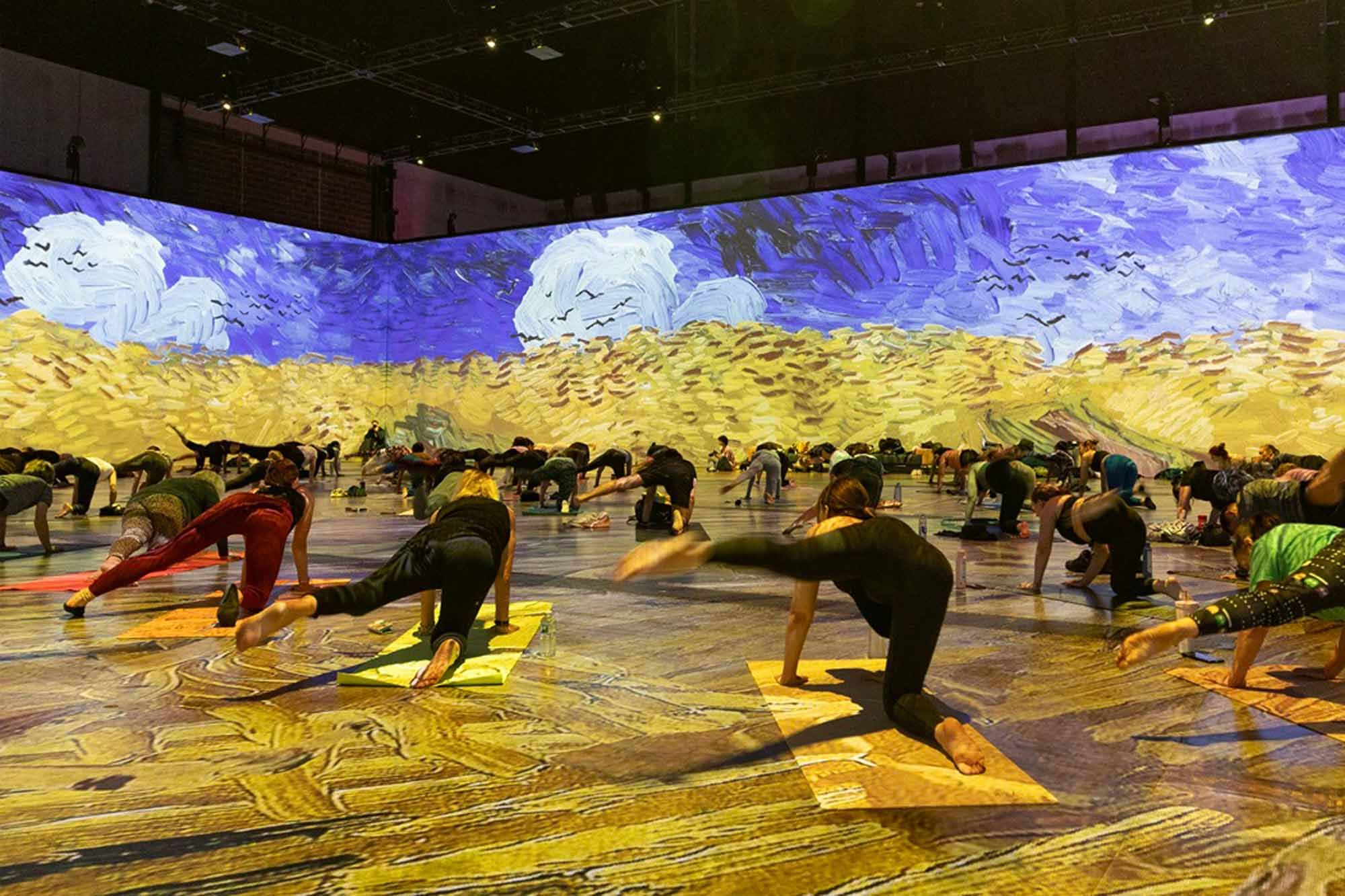
In her recent book Immediacy: or, The Style of Too Late Capitalism (Verso 2024), literary critic Anna Kornbluh offers Beyond Van Gogh as a paradigmatic example of ‘immediacy style’: the dominant cultural style, she argues, of our current moment. ‘Painting, panting, impressionism, immersion, gallery, studio: exhale’, she riffs. ‘It is all art; there is no art’. Today, Kornbluh claims, audiences mainly seek out cultural encounters that just ‘feel right’: situations of non-disruptive engagement in which self-affirmation and self-negation, absorption and distraction melt into one. Overwhelmed by ‘omnicrisis’, oppressed by privatization, and siloed in our own personalized feedback loops, we are not just lonely, but paranoid, polarized, and unfocussed. Why should we let art challenge and disorient us, when we already have enough uncertainty and anxiety to deal with in our daily lives?
In 2024, on the back of Immediacy’s success, Kornbluh was selected as one of ArtReview’s ‘Power 100’, the ‘most influential people in the art world’. In the years since it was published, countless reviews of Immediacy have appeared in cultural, scholarly, and progressive political outlets—a testament to the book’s ambitious project of both demonstrating just how pervasive immediacy style is and contesting its seductions. Kornbluh’s varying receptions in different cultural spaces are illuminating. The art world admires her take on literature, but views her discussion of video as ‘predictable’ and concludes that her work on ‘the culturesphere in general’ is lacking. Literary-oriented assessments praise her account of video, but view her criticisms of contemporary first-person narration as overly reductive. It appears that, depending on your knowledge base and personal predilections, something in the book won’t sit right with you. This is arguably inevitable given that Immediacy takes aim at so many lauded figures, from Karl Ove Knausgård and Rachel Cusk to Claudia Rankine.
Yet Kornbluh’s willingness to court controversy is unquestionably in tune with her commitment to making us question those objects of cultural consumption that allow us to ‘feel seen’. ‘Much of immediacy’s lure’, she argues, ‘rests in the momentary compensatory solidities of imagined contact with an imagined real’. In other words, it makes us believe that we are getting privileged access to an authentic whole or to some unfiltered, no bullshit truth—whether it be Knausgård’s insistence that there is no difference between the writer and narrator of My Struggle, or the protagonist of the hit TV series Fleabag speaking directly to the camera in a colluding tone that positions us, her viewers, as genuine friends and confidants. But if immediacy style gives us a certain positive feeling of realness, Kornbluh insists that it also entails the diminution of medium-specificity: the result is a hollowing out or loss of world-building capacities. In the case of writing, she diagnoses the increased ‘repudiation of fictionality and genre’, seen in the popularity of autofiction. In the case of video, she cites the hegemony of ‘the stream’, typified by ‘increasingly homogeneous customized content in a continuous loop of deformatted genre-fluid absorption’. Kornbluh also takes aim at new theoretical modes that, contrary to critical theory’s historical labors of generating distance and perspective, resist the struggle for concept formation entirely.
This is a position she shares with the philosopher Gillian Rose, who goes unmentioned in Immediacy, but whose work I found myself continually thinking about while reading Kornbluh’s book. Writing more than three decades ago, Rose’s target was ‘poststructuralist nihilism’, rather than the too late capitalism of today. Yet her language can be transposed with remarkable ease into the world of Immediacy. ‘The security of this new spectatorship’, Rose observes in her 1992 book The Broken Middle, ‘is undermined by the tension of freedom and unfreedom which it cannot acknowledge for it has disqualified the actuality of any oppositions which might initiate process and pain—any risk of coming to know’. It is this process (and risk) of coming to know—as opposed to the thrill of instant recognition—that Kornbluh insists we must embrace.
In the three years since Immediacy was published, we’ve witnessed an acceleration of immediacy style and culture, likely even beyond what Kornbluh could have anticipated. In her book, Kornbluh discusses the alienating effects of social media, endless smartphone scrolling, tv streaming, and the rise of hyper-personalized, algorithm-based content and advertising. Nevertheless, the onslaught of AI—and the brain rot and slop it generates—isn’t yet on her horizon. Likewise, for all her discussion of ‘stream style’, the livestream itself—its capacity to generate an abyss of unreflection in the streamer and tendency to create closed loops of trolling, extremism, and antisocial behavior—is not a central subject of analysis. For as Kornbluh herself points out in her acknowledgments, Immediacy was written ‘amid the long, lonely pandemic’, prior to Trump’s second term. Could she have known that the U.S. president would become a prime immediacy style trendsetter, posting offensive AI-generated memes and deepfakes as official White House communications? Could she have foreseen the mushrooming manosphere, populated by influencers like HSTikkyTokky, the paranoid subject of a 2026 documentary-exposé by British filmmaker Louis Theroux?
Now, more than ever, we’re living in an epoch of ambient and impulsive politico-aesthetic judgment: likes, emoji dumps, and gushing comments vie with daily purgatory activities of ‘unfollowing’ and ‘muting’ that we find considerably easier than responding to the doorbell. In Immediacy, Kornbluh repeatedly invokes the word ‘flow’ as a primary characteristic of both immediacy style and contemporary economics. ‘The twenty-first-century concentration on circulation, with its premium on flow, conditions immediacy as cultural style’, she asserts. And yet ‘flow’ doesn’t satisfactorily grasp the distinctiveness of these new modes of judgments (if we can even call them judgments), which seem to be impelled above all by a disjointed, serial variant of absorption, characterised by nothing so much as repeated distraction from our prior distractions.
‘Hyperpolitics’, a term that Anton Jäger argues encapsulates contemporary political life (and which he juxtaposes with the slower work of twentieth-century ‘mass politics’), provides a useful lens for comprehending such developments. Characterized by ‘the contemporary public sphere spasmodically convuls[ing] without ever crystallizing into durable [political] infrastructure’, hyperpolitics has clear parallels with ‘the notoriously short cycles of financial markets and digital media’. It ‘promises the re-enchantment of public life’, as everyone with a smartphone can now engage, protest, and cancel on any given day. Yet Jäger cautions that this politics without institutions is not just ‘low-cost’, but ‘low-commitment’ and ‘all too often, low-value’. Ultimately, he concludes, it is ‘the product of a hard but hollow environment, an attempt to break the iron grip of neoliberalism without the requisite tools to do so’.
Immediacy style, which Kornbluh describes as ‘a reaction to crisis that fails the bar of strategy, a reflex that is ultimately crisis-continuous’, is a symptom of this same iron grip. What future art and theory should offer us (and what it has historically offered us), she argues, is mediation, which she defines as ‘the active process of relating—making sense and making meaning by inlaying into medium’. With its connotations of painstaking handiwork, the verb ‘inlaying’ implies that a quality of resistance resides in the very medium that enables an artist to create. This recognition, in turn, encourages us to view those experiences of disorientation that often occur when encountering artworks in a different, more positive light. Could they in fact be what enable us to achieve new understanding, both of ourselves and the world we inhabit?
In its defense of mediation, Immediacy clearly telegraphs its historical materialist foundations—especially to pioneering theoretical responses to the entwined emergence of fascism and mass media in the 1920s and 30s. Kornbluh’s critique of ‘looping’—the stretching of the same content across film, television, and drama, as well as the proliferation of prequels and sequels—recalls Benjamin’s critique of the loss of the aura of the work of art in the age of mechanical reproduction, although Immediacy is less optimistic about the potential of new media than Benjamin initially was. In our age, Kornbluh suggests, ‘endless replication’ results in ‘distention without innovation’. For Adorno, she observes, ‘the very definition of thinking […] is nothing other than “the rejection of the overweening demand of bowing to everything immediate”’. Reading Kornbluh’s objections to aesthetic experiences that deploy ‘urgent extremities’ to ‘affright and awe’, I additionally sense echoes of the Situationist critique of spectacle.
In the age of Trump, fascistic spectacle returns as both tragedy and farce. Yet the countertendencies to immediacy style Kornbluh offers share little with the aesthetic strategies advocated by either the Frankfurt School or the Situationists—patience with what the ‘shock of the unintelligible’ might ‘communicate’, in the case of the former; and ‘détournement’, a critical-creative practice that returns ‘subversive qualities’ to forms and judgments ‘that have congealed into respectable truths’, in the case of the latter. Her own examples, discussed in Immediacy’s final chapter, include the Canadian artist Edward Burtynsky’s large-format photographs of manmade interventions in nature, as well as novels by contemporary Black writers that make use of free indirect discourse. Burtynsky’s photographs, Kornbluh ambiguously asserts, ‘use the image not to mirror but to precipitate otherness, inviting us to traverse obscure zones and to construct for the good’. The present day value of free indirect discourse, she suggests, lies in its ability to offer synthetic and collective perspectives, which she argues manifests as a ‘finely figurative social realism’ in the cases of Colson Whitehead, Brandon Taylor, and Diana Evans.
![Edward Burtynsky, 'Salt Pans #13 [Little Rann of Kutch Gujarat, India]', 2016. Archival pigment print, 148.6 x 198.1 cm.](https://cdn.sanity.io/images/9ov8nnx3/production/763ac4fdc98ac985cb1080dfe2045aafaa0a5bf4-2000x1501.jpg?w=2000&h=1501&auto=format)
I remain unconvinced that an enormous photograph of a salt pan is the most successful antidote to immediacy style, however stimulating such an image may be, although Kornbluh is surely right to insist that we ought to continue to take the affordances of free indirect discourse seriously. We need only revisit the works of Eliot or Flaubert to see that its narrative capacities can be extraordinary. Still, it seems a missed opportunity to insist that more free indirect discourse is the best way forward for literary mediacy. Our current cultural and political moment is profoundly different to the world of her theoretical influences—something Kornbluh clearly recognizes, for even as Immediacy remains committed to affirming mediation, it assiduously avoids identifying with the legacy of modernist difficulty and elitism, as well as the heroic, masculine avant-gardism it has embodied for many.
We unquestionably need to foster a more inclusive and hospitable cultural sphere. Yet in doing so, I’d ask, could work that centres those tensions Kornbluhat times glides over—between high and low, between experimental and conventional narrative methodologies—open up futures for art that remain unacknowledged within the pages of Immediacy? Certainly, Kornbluh’s sustained attention to—and dogged insistence that we face—the problems of immediacy style across disciplines and cultural modes is what allows Immediacy to gather its remarkable force and amplitude. Perhaps the greatest compliment I can give Kornbluh is that I found her book unignorable. Nevertheless, her seemingly categorical rejection of immediacy troubles me insofar as it sits at odds with Immediacy’s own insistence on the values of personal deliberation and struggle, process, and a slower timescale of socio-cultural appreciation. For if immediacy style is indeed as pervasive, seductive, and politically symptomatic as Kornbluh makes it out to be, both the viability and appropriateness of any such categorical rejection must be open to debate.
One of the most valuable capacities of art remains its ability to take the pulse of society, to comment on and respond to the condition in which we find ourselves—at times obliquely, at times more directly. The question thus arises: if immediacy is constitutive of our current moment, however much we might wish it otherwise, shouldn’t contemporary practices of artistic mediation somehow engage with this reality?
On the surface, the idea that mediation ought to have more, rather than less, to do with immediacy might appear paradoxical. Yet a number of contemporary artists and writers help us to see why it isn’t so. In such work, much of which has been created since Immediacy’s publication, there is no dream of conceptual or artistic purity, but rather a negotiation with and within the world as it exists presently. In practice, this means the advent of what I’d call mediated immediacy: of art objects that may flirt with the aesthetics of commodified desire, but nevertheless withhold what we think we want.
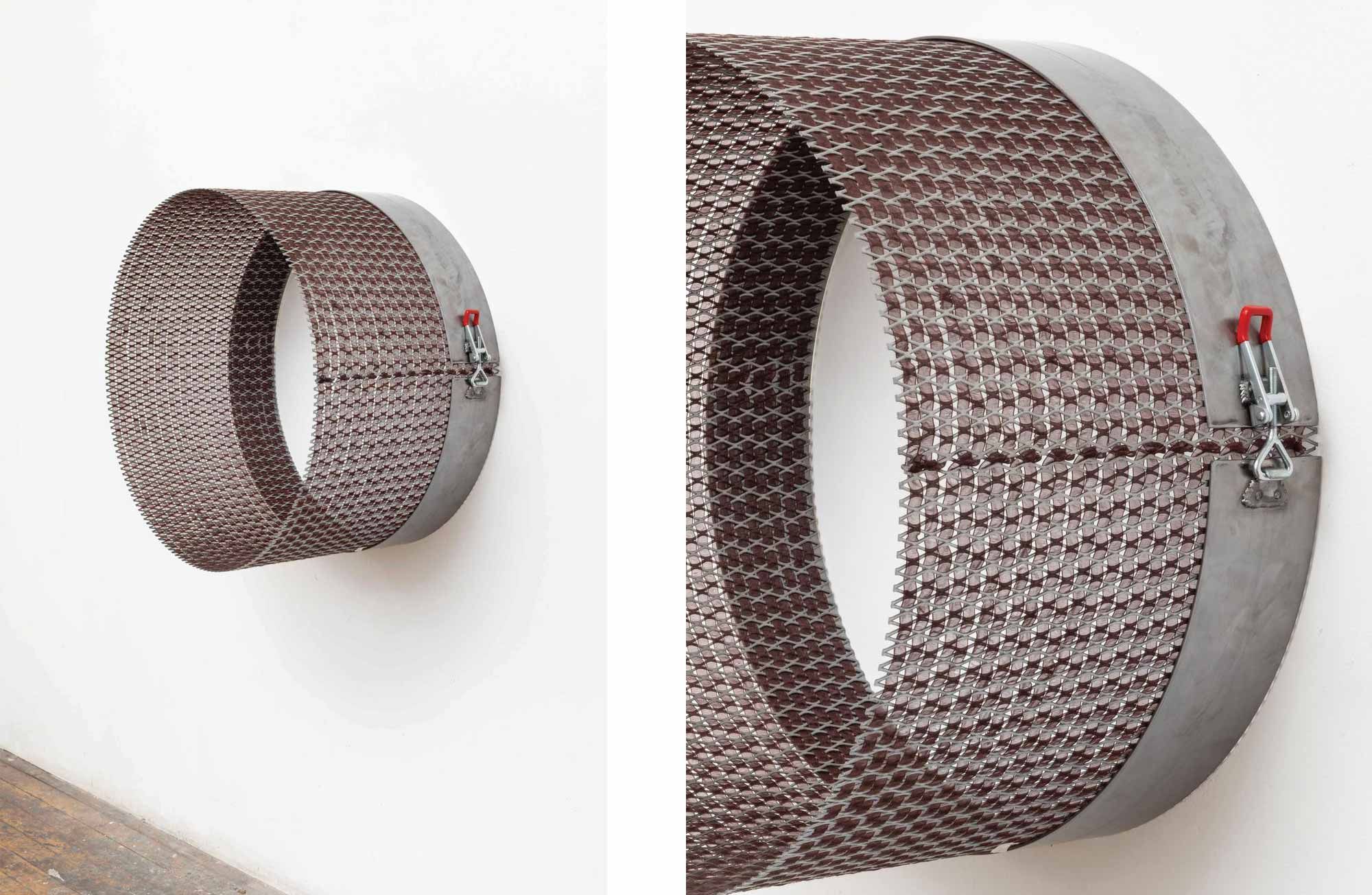
Consider the unassuming sculptural piece Corridor (2025), made by Ukrainian-born artist Alina Tenser. At once fast and slow, slick and resistant, Corridor rebuffs easy reading despite its highly legible cylindrical form. What am I supposed to be looking at or through? Why is it affixed to the wall? If it is a corridor, where does it lead? New sensations and thoughts begin to emerge, I’ve found, only as an initial sense of recognition disintegrates. All this means that an experience of delay or belatedness is crucial to Corridor’s effect: exactly the opposite of immediacy style.
At first glance, Corridor reminds me of nothing so much as a spring-form baking pan. The metal clip, its bright red tip calling out for attention, suggests an object designed to clasp or hold. Yet any such function is also refused: both because of the vertical placement of the cylinder, which encircles nothing more than air, and its porous, net-like structure. An organza ribbon, meticulously woven through the netting, further undermines functionality, as well as introducing a softer, decorative modality to a work that might otherwise be perceived as overly indebted to the visual vocabulary of postwar minimalism. Tenser is clearly committed to playing with art historical and feminist tropes: an approach, in the case of Corridor, that necessitates working through (one could say ‘declassing’) both the iconic forms of masculine minimalism and the materialities of reproductive labor (cleaning, cooking, etc.) that are often glamorized by conservative social media.
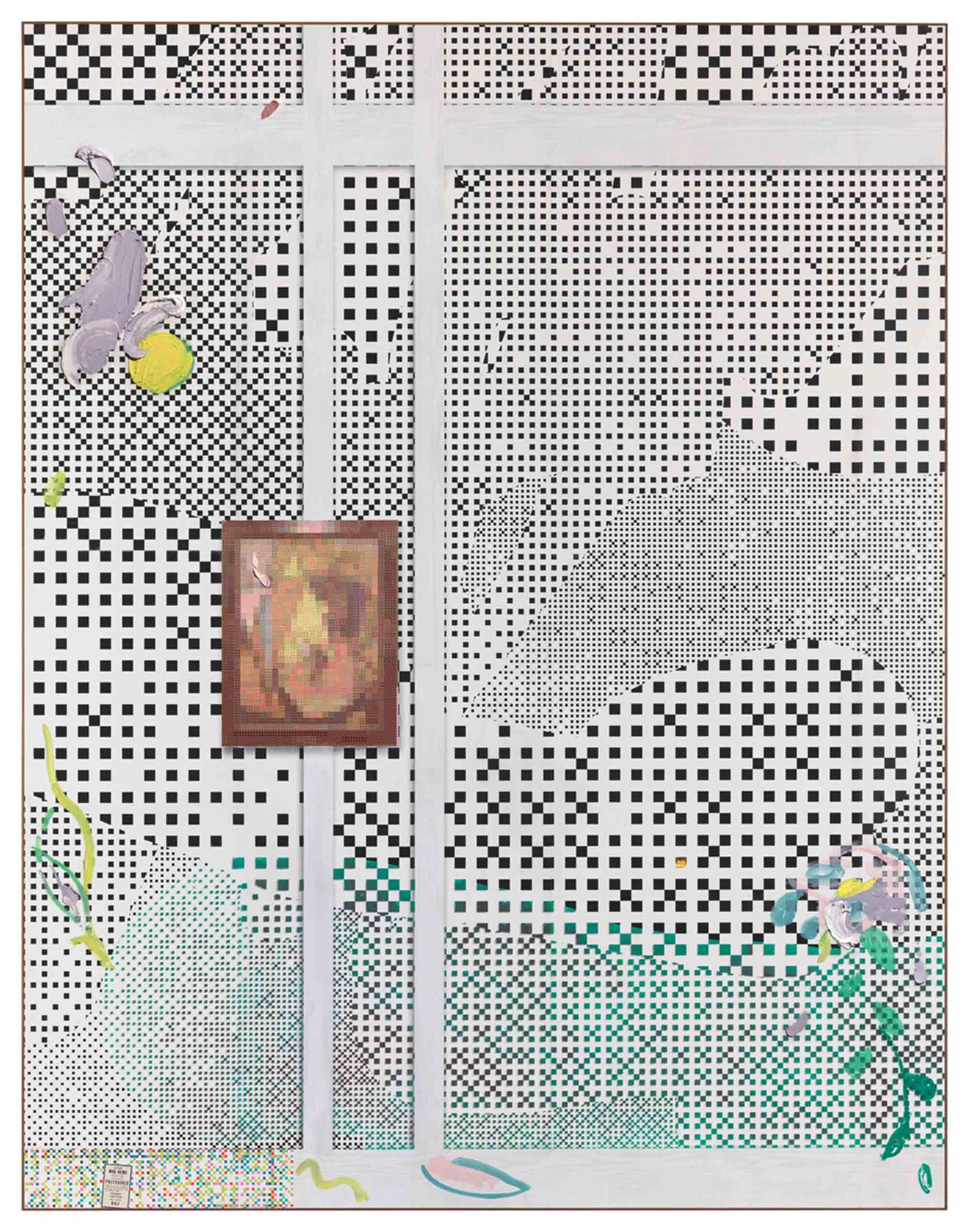
While the paintings of Laura Owens operate somewhat differently, they demand a similar admixture of patience and openness on the part of the viewer. Also like Tenser, Owens integrates visual languages and styles into her work not usually associated with high art: an approach she attributes in part to her childhood in a conservative Ohio town, where there was very little going on except for ‘thrift stores, Kmart, football, corn’. I’d invite us to think about Owens’s art as itself a practice of thrifting: a taking and using of found forms and imagery that the maker may initially experience as antagonistic or inhospitable (Owens has also spoken about her strong sense of not fitting in while growing up).
In more recent abstractions, Owens especially mediates immediacy by incorporating into her practice an aesthetics of the glitch. By this, I mean that such work plays upon the viewer’s expectation to see something coherent, to categorize and classify, and to abide by fixed binaries—including and social and gender binaries, as Legacy Russell argues in her book Glitch Feminism. In Untitled (2020), Owens’s use of the recognizable trope of the digital pixel—inconsistently sized and blurred—partially enables this effect. Yet the primacy of the pixel is simultaneously placed under pressure as the smaller squares resolve visually into ‘x’ marks that evoke the contrastingly analog practice of embroidery. Moreover, Owens’s decision to affix a small walnut frame to the painting—an explicitly lo-fi move—further jars its already glitchy 2-D surface. As viewers, we must then remain perennially caught between looking through and looking at, uneasily aware of our own unstable relationship to the image rather than fully immersed in what is in front of us.
The generative possibilities inherent in an aesthetics of the glitch return us to the issue of our decreasing capacity to hold tension and contradiction in play in our current environment of ‘scopic capitalism’: a capitalism, as diagnosed by sociologist Eva Illouz, in which the body is transformed into primarily ‘a site for consumption, shaped by consumer objects’, and the gaze becomes ‘an essential instrument’ for extracting ‘aesthetic and sexual value’. One of the most compelling contributions of Immediacy is the work it does to explore the role of the imaginary in this process of extraction. For Lacan, the imaginary comes to the fore in the mirror stage, in which the infant, perceiving their reflection, assumes that image as their own and becomes ‘caught up in the lure of spatial identification’. In this context, all is identification or disidentification, projection or rejection.
Not only does the imaginary help us to comprehend the recent upsurge of an aesthetics of extraction, Kornbluh suggests, but also of corollary impulses to oppose or ‘disject’ (to use the psychoanalytic term) anything that does not confirm to one’s worldview. For ‘in the imaginary’, she observes, ‘self and other only relate as […] two wholes, in binary “rivalry”’: a situation she contrasts with participation in what Lacan theorizes as the symbolic order, the register of language, norms, and social complexity. Such an existence—stuck in the imaginary, failing to access the symbolic—is symptomatic, Kornbluh concludes, of the lived experience of society today, in which ‘immediacy’s stylized engrossments mimic our epidemic paths of suffering’ and ‘its inundative presence swallows the horizon of no-future’. Confronted with the regime of scopic capitalism, it’s inevitable that we’ll try to find ways of deferring the risks and discomfort of self-integration, as well as the struggles of collective world-building.
This diagnosis underlies Immediacy’s especially polemic criticism of literary first-personalism—for Kornbluh’s position is that such writing functions primarily as a nihilistic technique of consolation. Yet she has also shown us that it’s possible to think synthetically across media and mediums, raising the possibility of contemporary uses of the first-person ‘I’ that engage immediacy style without reproducing its dulling ‘engrossments’. Particularly interesting in this regard is Ben Lerner’s latest novel Transcription, which won the 2026 Orwell Prize for Political Fiction. In Immediacy, Kornbluh cites Lerner’s earlier novel 10:04 (originally published in 2014) as a problematic example of the unmediated autofictional tendency. However, Transcription, similar to the work of Owens and Tenser, resists mirroring those experiences of absorption and flow facilitated by our devices. Instead, this novel considers what happens when the first-person narrator, an artist and writer, drops his phone in the sink and finds himself suddenly untethered from the digital world on which he has come to rely: ‘I was glitching, craving my cellular phone on a cellular level, shamefully unresponsive to the old media that surrounded me’.
If Transcription simply narrated this experience as a passing anecdote, it wouldn’t amount to much more than a meme. But Lerner makes it foundational to his novel, which at once structurally and discursively activates this experience of being caught out, of remembering but also misremembering, of finding oneself between or elsewhere, simultaneously misunderstood and trying to understand. Such internal dissension is facilitated by, and contained within, the novel’s neat tripartite form. The first section relates a dialogue between the protagonist and his mentor, whom he has visited in order to conduct an interview for a magazine. Unable to confess that he does not have a working recording device, the protagonist proceeds under false pretenses. It is the mentor, however, who most forcefully confronts the question of fictionality, including by suggesting that we can partake of other people’s dreams. In section two, the narrator confesses his recording failure in a eulogy given for his mentor at an academic symposium. Yet in doing so he discovers that he has deeply offended the other participants, who are invested in excavating the truth of the mentor’s life. Part three stages a dialogue between the protagonist and his friend, who happens to be the mentor’s son. This section is constructed primarily out of the narration of the son, who offers an intimate account of his daughter’s struggle to eat—an account that aims to make sense of the role that unboxing videos, however much he disapproves of them, have played in enabling her to overcome her difficulties.
Taken as a whole, then, Transcription is a novel that structurally and topically foregrounds—and to some extent reproduces—the lures of immediacy style, pulling us as readers into the orbit of a conversational, relatable protagonist. At the same time, the narrator becomes a site for taking up the labors and struggles of mediation. For if he’s an avatar for cultural anxieties (and the author himself), he’s equally a literary tool for testing why fiction could still matter—as, for example, what enables us to recall the capacities and uniqueness of our humanity in the face of AI: a humanity that can still incline itself to, and care for, the other while acknowledging those tensions, ambivalences, and differences that make this opening of the self so challenging.
What does it mean to respond truthfully, and with humility, to the condition in which we find ourselves? Don’t we all, in some small way, want to ‘construct for the good’? Is this impulse radical, or just human? Where can it lead us when we allow ourselves to cultivate it? These aren’t fashionable questions. Yet I’m increasingly convinced they’re ones we need to ask ourselves today.
It’s not surprising that we’re more comfortable, on the one hand, vibing on negativity, or, on the other, endeavoring to negate that negativity in the service of maximal, indisputable purposiveness—the good sanctioned by the market, and by cultural institutions whose concept of the good is underwritten by the market. Endlessly, we’re asked to prove the value of what we make and do—and, by extension, our own value: a disabling demand if there ever was one, and itself a valid reason for seeking solace in immersion and flow. Both outcomes are arguably the consequence of a false choice—between absorption and disjection—that too late capitalism presents as inescapable. It is this binary choice that works like Corridor, Untitled, and Transcription enable us to recognize and contest—not by repressing the lure of immediacy, but through an attentiveness, as well as a canny infidelity to, the extractive logics that dominate contemporary culture.
To thrift, declass, and glitch, to take both the affordances and normativity of form seriously: art of the kind made by Tenser, Owens, and Lerner shows us that these are viable routes for creative practice. Their works neither engross nor diminish us, but do something rather different. They ask us to deliberate; to relate without demanding self-sameness. They invite introspection and breadth. The result: a more generous and hospitable mediacy.