LITTLE BOXES
We live in a gridded world. Your table cloth and bathroom tiles, the floor plan of your house, the shape of your tablet, the circuitry in your computer, your windows and doorways, maybe even your route to work and the spreadsheets organizing your data: it’s all shaped by grids of squares and rectangles, with their intersecting lines, horizontal and vertical. A gridded world of little boxes.
What interests me most about the grid is its basic contradiction. On the one hand, the grid is a stabilizing force, offering clarity and comfort in the midst of chaos. On the other, it is a force of division, emphasizing separation and enclosure. The grid creates a larger whole, but only by partitioning space into smaller units. In this way it visualizes the contradiction at the heart of social life itself: that society is made up of individuals, and individuals are produced by a society, but the two are in a constant state of tension with one another. This is the tension underlying Little Boxes, an exhibition that explores squares and rectangles as both organizing principles for art and underlying forces shaping society.
This spring I visited the Addison Gallery of American Art on the campus of Phillips Academy in Andover, Massachusetts—a small museum near my hometown that never disappoints—to see Little Boxes. It was a warm, quiet day. A handful of students were walking across the quad. The trees were starting to bud out and the smell of lilacs perfumed the air.
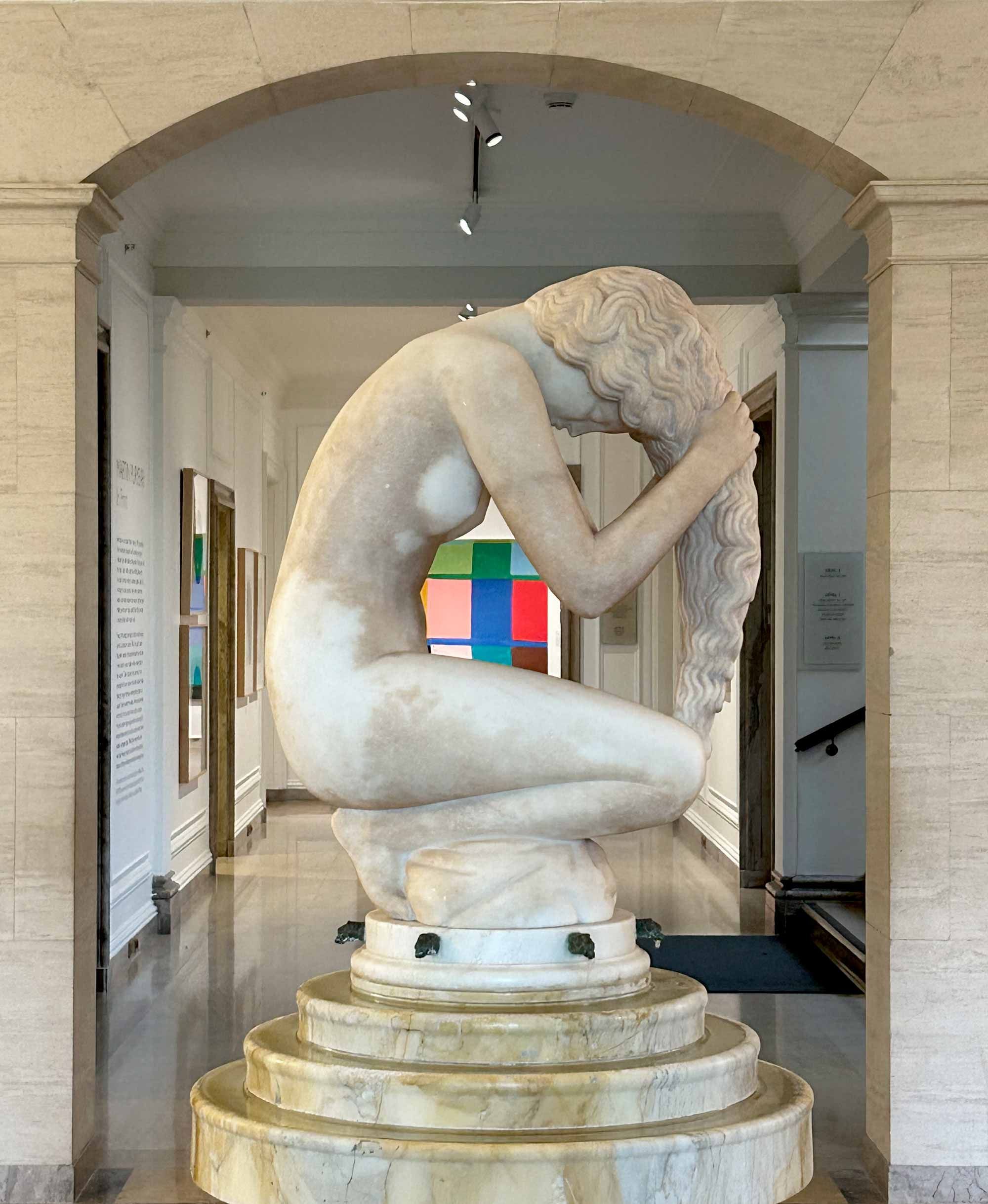
When entering the museum’s rotunda, I immediately encountered Venus Anadyomene (1927) a modestly sized statue of a naked girl washing her hair. Sculpted in marble by Paul Manship specifically for the museum space, the sculpture includes a water feature that has never worked as intended, causing a perpetual state of humidity for the entranceway. We see the kneeling Venus drying her hair after emerging from the ocean. She is composing herself as she transitions from ocean to land.
The youthful figure seems apt for this entryway. As we transition from the museum’s outdoor space to the indoor gallery, we are invited to shift our position, and hopefully—by viewing art—see the world and ourselves in new ways. Between the figure’s lowered breast and risen thigh, I saw what looked like a large stained glass window in the distance. Its radiant jewel tones beamed down the marble hallway and seized my attention. The coloured planes were part of Stanley Whitney’s opaque oil painting See see Love (2021), and indeed not stained glass. It is the first painting you see when entering Little Boxes.
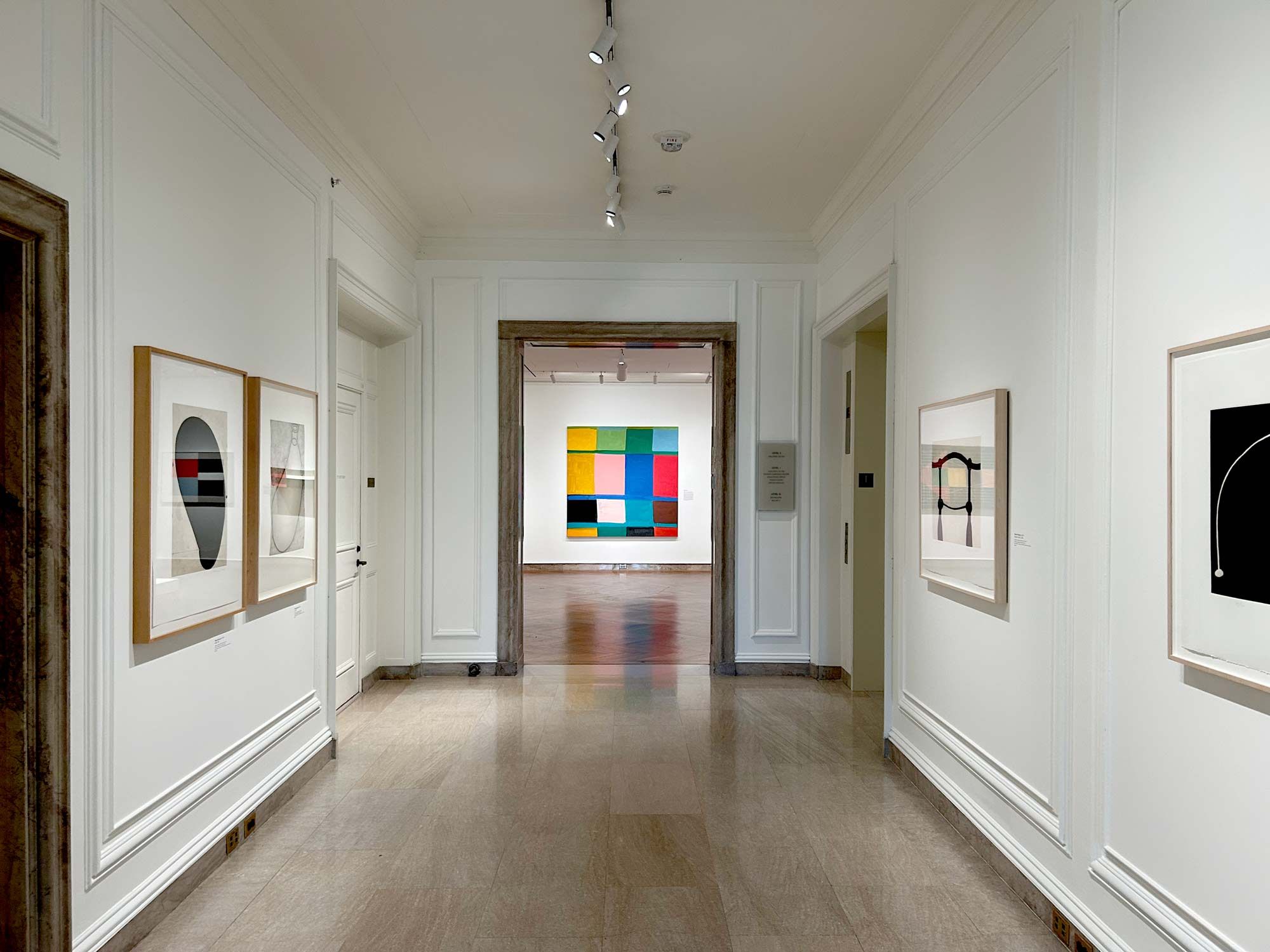
During the early twentieth century rectilinear geometry was considered a utopian form. Modernist artists like Kazimir Malevich, movements like De Stijl and schools like the Bauhaus used geometric abstraction—squares, rectangles and grids—to convey a message of unity and future progress. Geometry was celebrated as our common sense, and the grid became the organizing principle of modern painting. Grids would find their way into public housing projects, at first seen as progressive and egalitarian, but later as standardized and soulless. Little Boxes begins just after that hopeful moment of utopian modernism and follows the changing fortunes of rectilinear geometry through the second half of the twentieth century in America.
The title of the exhibition comes from Malvina Reynolds’s 1962 song Little Boxes which satirized the uniformity of American suburbs after WWII. As GI’s returned home after the war, there was huge demand for cheap, convenient housing. To meet this need, developers expanded the suburbs, creating an explosion of cookie-cutter subdivisions across the country. With this boom of generic housing in the 1950’s came a culture of convenience, cleanliness, and uniformity.
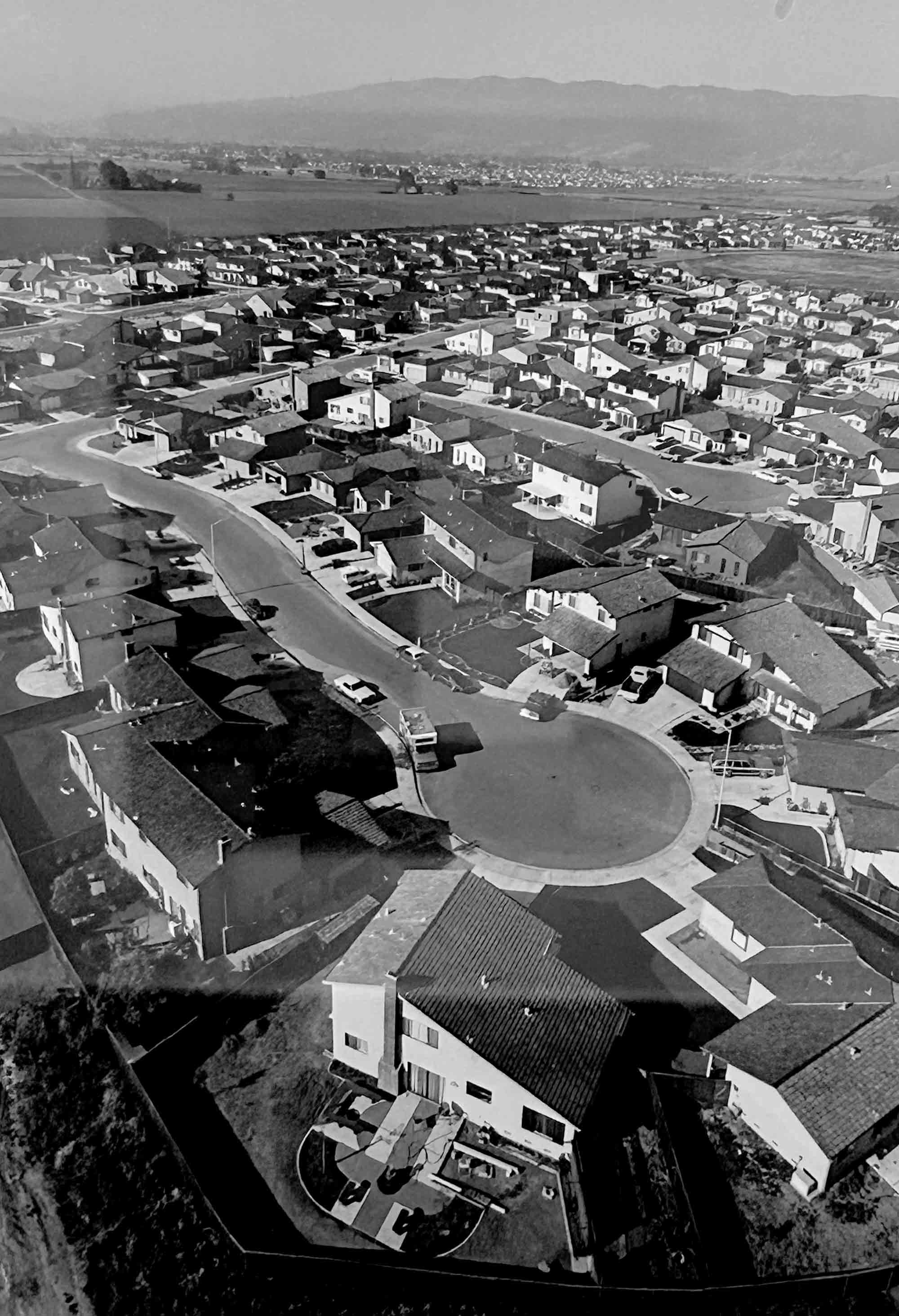
Through painting, sculpture and photography, the exhibition explores squares and rectangles not simply as a formal language but as a social one, the little box appearing as both a unit of belonging and a site of isolation. Bill Owens’s photograph Suburbia (1972) gives us a clear example. Owens lived in Livermore, California and worked as a photojournalist for the local newspaper. In this photo a mountain ridge sits in the distance while a grid of near-identical houses spills forward. What interests me most is the foregrounded cul-de-sac. Its slow, wiggly shape mimics the distant mountain ridge and reminds me of a cartoon sperm pushing against its environment. Around it a grid of streets and houses repeats outward. Even though the cul-de-sac introduces curves into the gridded neighborhood, it remains a dead end.
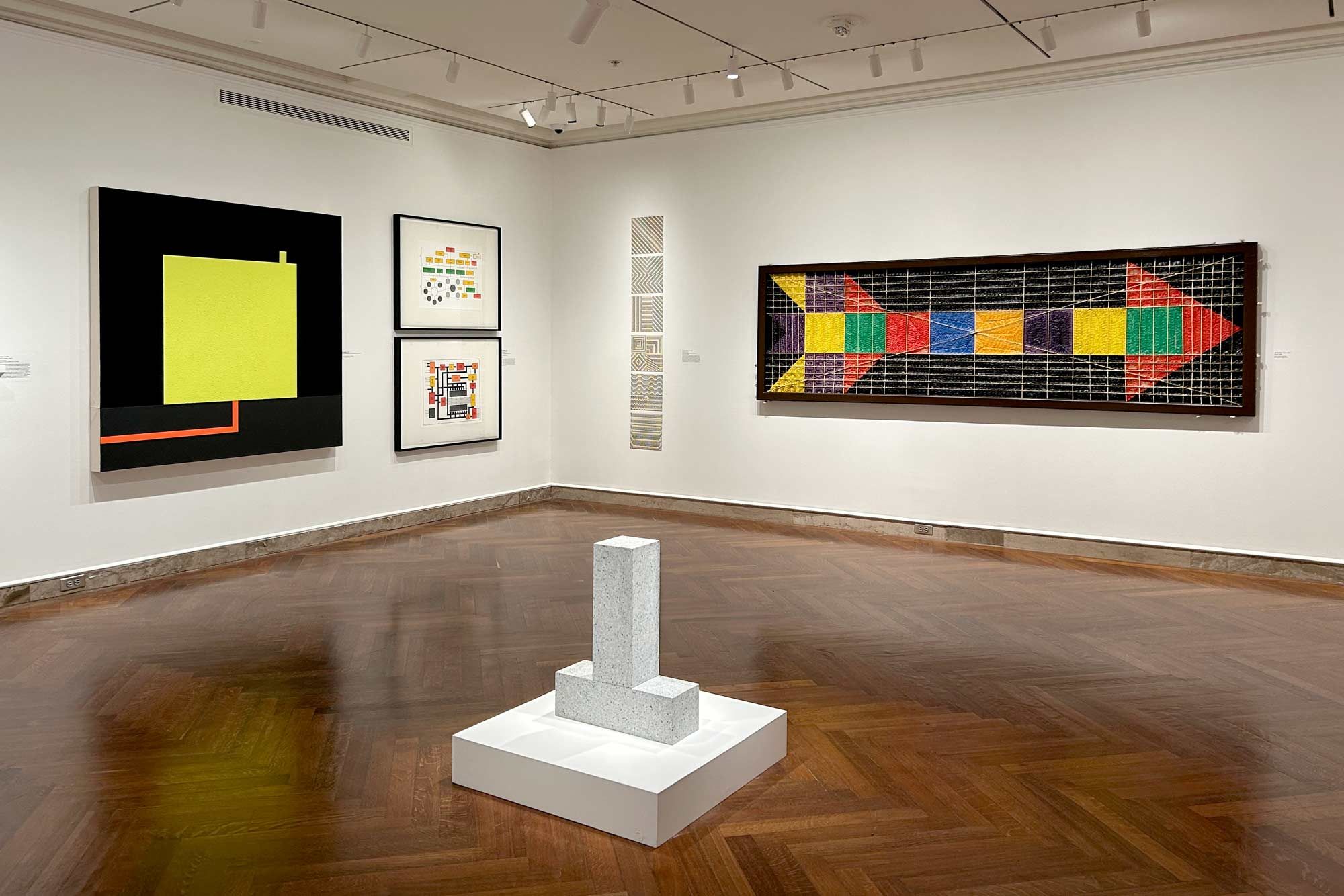
Carl Andre’s sculpture Manet Inverted Tau, New York (1980) stands to one side of the gallery. It is a small sculpture, about knee-height, composed of two granite blocks arranged in the form of an upside-down T. The title “Inverted Tau” describes the form, Tau being the Greek letter T. I don’t understand the reference to Manet, but perhaps it acknowledges Manet’s transitional position between traditional and modern art.There is both a calming and impenetrable quality to Andre’s sculpture. The simple forms are totemic and meditative. The sculpture projects a quiet strength but also a sense of lack. Gravity alone holds the work together. Its sheer weight is what keeps it standing.
By the time Andre made this sculpture in 1980, attitudes toward geometry had changed. A younger generation of artists sought to reframe squares and rectangles in the context of consumerism and social control. This approach was epitomized by Peter Halley, who in his 1984 essay “The Crisis in Geometry” argued that geometric abstraction could no longer claim autonomy from everyday life. In Halley’s paintings the modernist grid is no longer an idealized form but a prison, conduit, wall or screen.
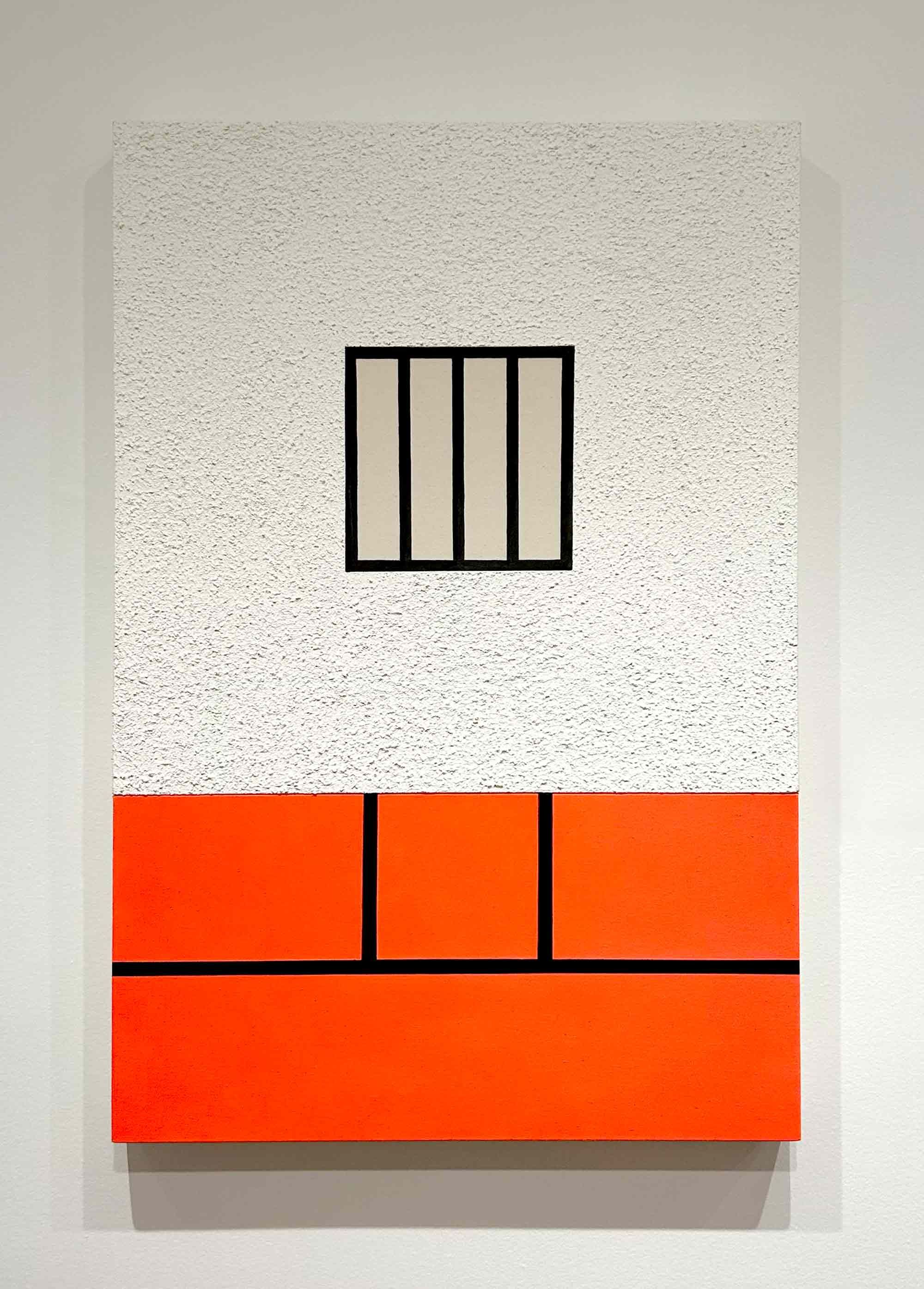
Of the four Halley works on view, Prison with Conduit (1981) is an early and particularly stark example. The lower canvas is painted in an overwhelming Day-Glo red, the kind that burns into your retina. Black lines divide the red field into compartments, suggesting an underground network of cables or pipes. Above sits a rough grey square with the icon of a prison window painted at its centre. The blinding red, despite being radiant, is positioned underground, suggesting that the real power is churning beneath us. The assessment is grim and difficult to deny. Yet what makes Halley’s paintings so effective is that their seductive colour never allows them to become mere illustrations. I found myself captivated by the painting even as I absorbed its bleak diagnosis.
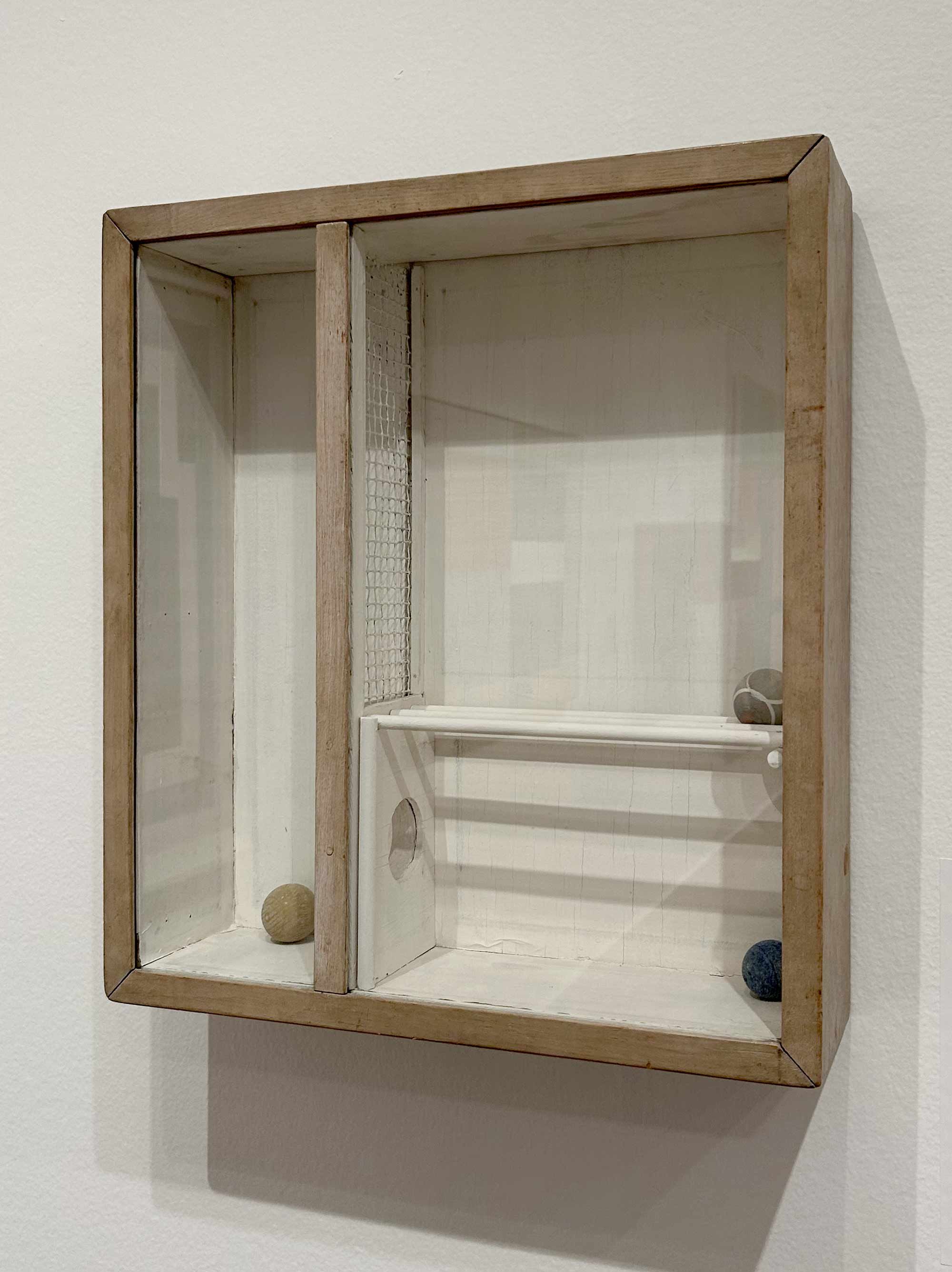
Hung directly to the left of Halley’s painting is Joseph Cornell’s Cage (1949). Although differing completely in sensibility, the two works have a remarkable kinship. Known for his window-like constructions, Cornell was a self-taught artist who had a defining experience encountering an exotic bird caged within a pet-shop window. Cage, however, is almost entirely absent of things. It feels like a room recently vacated. A few wooden balls sit separated from one another within a sparse arrangement of shelves and partitions. You might think Cornell’s beige-on-white construction would disappear next to Halley’s bombastic red, but it doesn’t. Cornell’s Cage possesses a quiet, heartbreaking resilience. The pairing is one of the exhibition’s strongest curatorial decisions. Despite their radically different sensibilities, both artists are responding to the same condition. Both ask what it means to be caged. Both visualize a world in which the subject has gone missing while the structure remains.
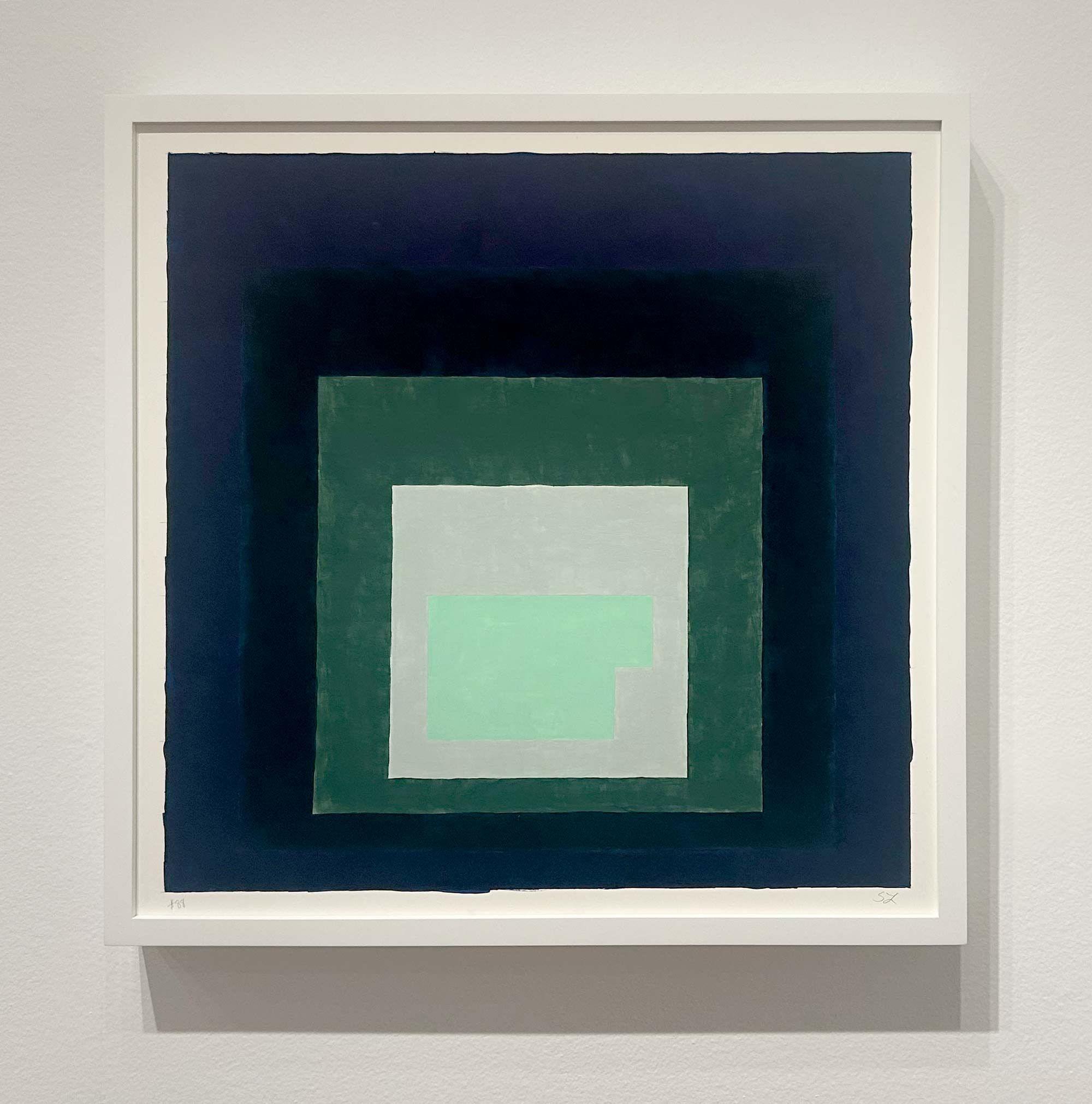
Nearby I saw the best Josef Albers painting I had ever seen. It appeared to be one of his Homage to the Square paintings, but something felt different. The colours were more vibrant and the edges noticeably looser. I then realized the smallest internal square was not a square at all but an irregular block. Reading the wall text I discovered I was looking at Steven Locke’s Homage to the Auction Block #88 Arc-light (2021). Like Halley, Locke changes the way we see geometry. The central form is the shape of a specific auction block where enslaved Africans were sold. The effect is subtle but devastating. What appears at first to be an abstract geometric form reveals itself to be embedded within a history of violence and domination. Locke’s painted critique isn’t ironic or a gimmick. It is a genuine, heartbreaking, connection being made visually, the kind that works its way into you before you know it’s there.
Whitney’s See see Love, painted the same year as Locke’s, is the work that greeted me when I entered the exhibition and the work I kept returning to in my mind afterwards. Whitney has developed a fairly straight-forward process of making his paintings, not industrial or streamlined, but also not unruly. Whitney’s spontaneity is confined to the logic of the grid which he bends and loosens. His grid is soft and slightly irregular. The horizontal lines wobble. The colour is where we find the excess. Mixed intuitively on the fly, the overall composition is always a bit of a surprise, some happier than others, some more downbeat than the next.
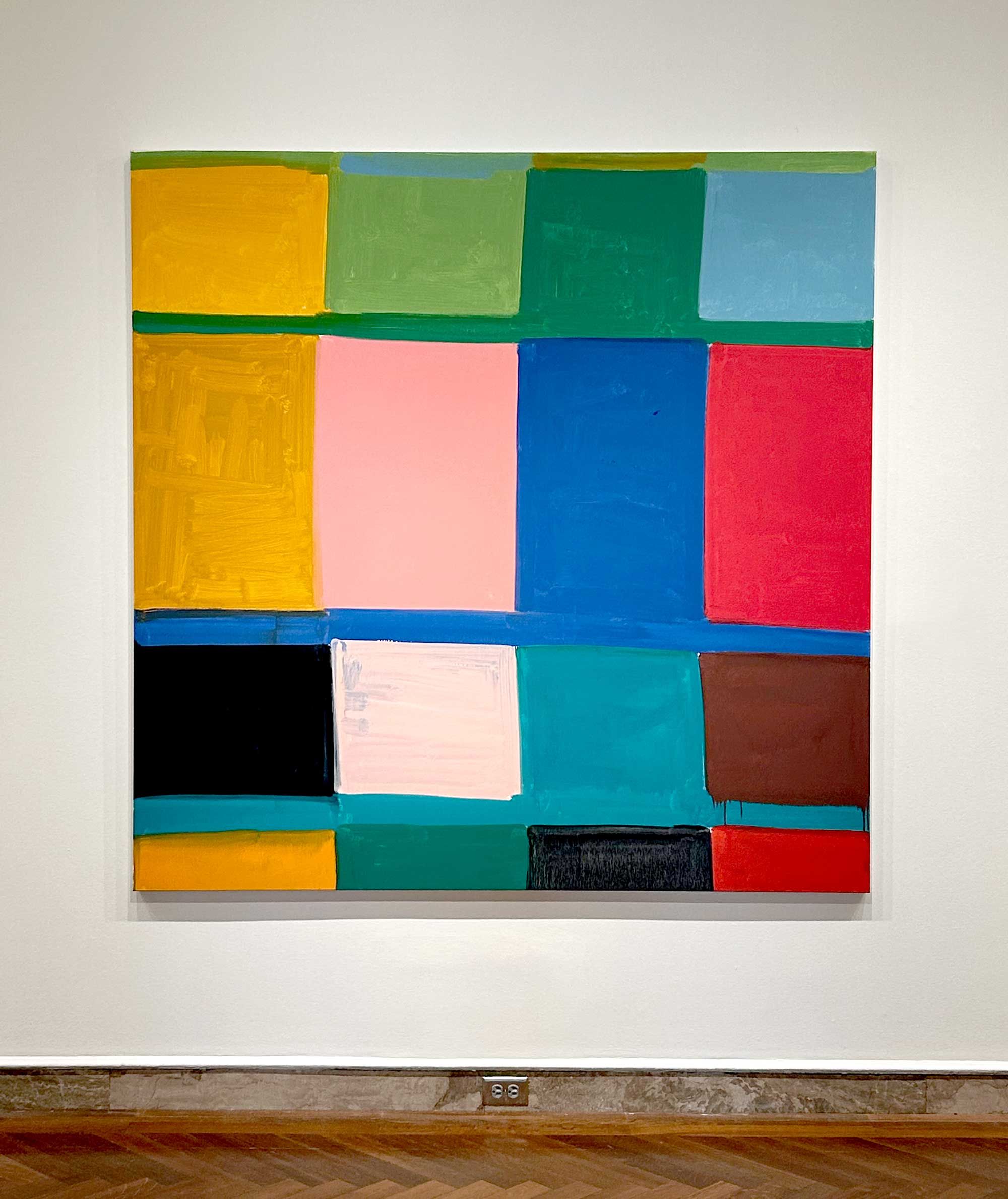
To me, Whitney’s recent work with oils feels polite, especially compared to Halley’s garish colour schemes. They feel more relatable, colours we want more of—the palette of Matisse rather than the glow of a computer screen. They are friendlier than Andre’s aloofness and more amicable than Locke’s alarming critique. Maybe the little boxes in Whitney’s paintings are just not so worried about being little boxes. It is an attitudinal shift rather than a structural one.
I believe we still live within Halley’s doomsday scenario. The networks, enclosures and systems that concerned him have not gone away. Whitney’s approach can sometimes make this seem okay, a kind of contentedness that feels slightly naive within the context of this exhibition.
And yet perhaps that is also Whitney’s strength. He does not reject the grid or pretend to escape it, nor does he return to the modernist fantasy that geometry can transcend history. Each coloured rectangle remains distinct while participating in a larger whole. The individual and the collective remain in tension, neither overcoming the other. If the earlier works in the exhibition show us the costs of the grid, Whitney suggests that living within its contradictions may be the best we can hope for.